Death Valley Scotty Historic District
Why it's listed
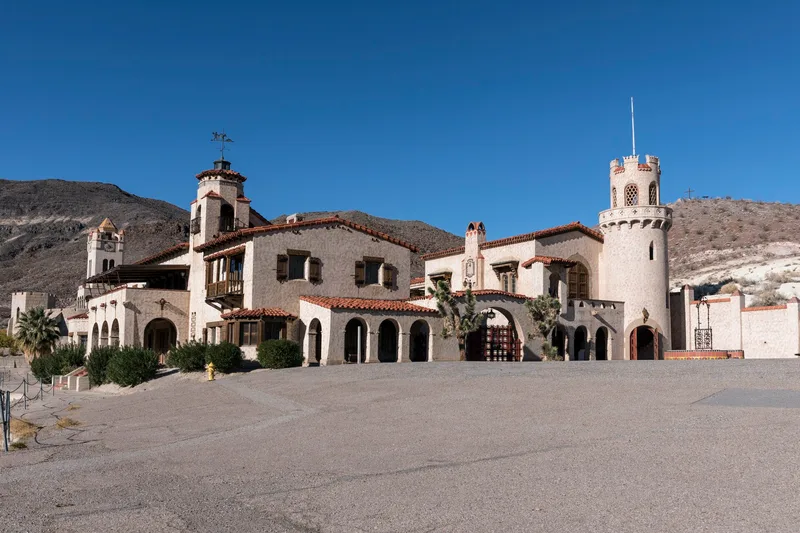
Two building complexes in Grapevine Canyon, on the western slope of the Grapevine Mountains in Death Valley National Monument, make up this district: Scotty's Castle and Scotty's Ranch. Chicago insurance man Albert Johnson bought the land around 1916 and, starting in 1922, built a ranch retreat. His wife Bessie Johnson pushed for a remodel in what she called "Provincial Spanish" style, with engineer Matt Roy Thompson leading construction. The Castle has a Main House and Annex, a Hacienda, a five-story Chimes Tower, a powerhouse, a stable, a solar water heater and an unfinished swimming pool. Work stopped in 1931 after Johnson's Depression-era losses. Five miles down the canyon, Johnson built a small bungalow and outbuildings at the ranch as a home for his friend Walter Scott, known as Death Valley Scotty. Scott became a legend through publicity stunts and tall tales about gold mines. Scott's grave lies on a hill above the Castle. The ranch buildings are vacant, while the Castle is used for tours.
Machine-generated summary. This summary was generated by a language model from the official nomination document and has not been reviewed line by line by an editor. It may contain errors. Check the source document before relying on any detail. Source: nomination document (PDF) · catalog entry. Generated October 2026 (model claude-sonnet-5-5, prompt v1.0-2026-10-29).
| Styles | "Provincial Spanish" (Mediterranean, Mexican and Spanish influences) |
|---|---|
| Areas of significance | Prehistoric, Art, Architecture, Social History, Invention |
| Acreage | 1778.1 |
| Boundary source | NPS cultural-resource GIS polygon |
| Full listing page | Death Valley Scotty Historic District (property record) |
What listing means for this property
This is a historic district. Buildings within its boundary are either contributing (they add to the district's significance) or non-contributing. Owners of contributing income-producing buildings can claim the 20% federal rehabilitation tax credit; homeowners should look at state credits. National Register districts impose no design review by themselves; a local historic district ordinance, if one exists, does (the difference explained).
General information, not legal or tax advice. Rules change; confirm with your State Historic Preservation Office or a qualified adviser.