Court at 533-549 North Lincoln Avenue

The National Park Service has not published a boundary polygon for this district; the map shows the listed properties inside it and the district's reference point.
Why it's listed
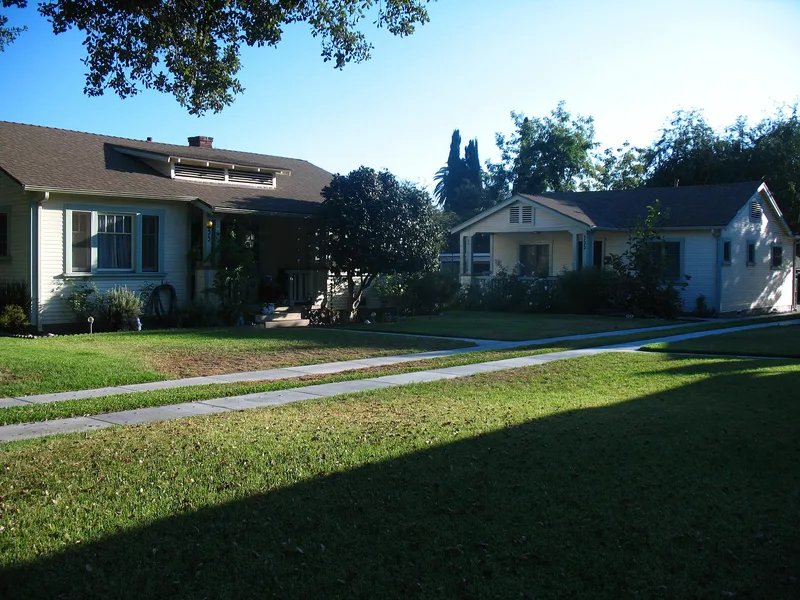
This bungalow court in Pasadena consists of four one-story wood-frame houses on a lot 120 feet wide by 161 feet deep, arranged in a U around a shared lawn and courtyard with a driveway through the middle. Built between 1922 and 1925 for owner T. G. Grabham, the units cost between $3,000 and $3,525 each. G. Tombleson designed the first two houses, numbers 533 and 535, in 1922. Number 545 followed in 1923, built by Whitescarver & Pieton, and number 549 was added in 1925 by contractor Joseph G. Roth. The houses show late Craftsman features in simplified form, including low-pitched gable roofs, exposed rafter tails, and attic vents at the gables. Numbers 533 and 549 closely resemble a Pacific Ready Cut design from 1923. The court was listed for architecture as one of the best examples of the detached, enclosed bungalow court form in Pasadena. Roofing has been replaced and two garages removed, but integrity remains.
Machine-generated summary. This summary was generated by a language model from the official nomination document and has not been reviewed line by line by an editor. It may contain errors. Check the source document before relying on any detail. Source: nomination document (PDF) · catalog entry. Generated October 2026 (model claude-sonnet-5-5, prompt v1.0-2026-10-29).
| Period of significance | 1922-1925 |
|---|---|
| Styles | Bungalow/Craftsman |
| Areas of significance | Architecture |
| Acreage | 0.9 |
| Boundary source | not published |
| Full listing page | Court at 533-549 North Lincoln Avenue (property record) |
What listing means for this property
This is a historic district. Buildings within its boundary are either contributing (they add to the district's significance) or non-contributing. Owners of contributing income-producing buildings can claim the 20% federal rehabilitation tax credit; homeowners should look at state credits. National Register districts impose no design review by themselves; a local historic district ordinance, if one exists, does (the difference explained).
General information, not legal or tax advice. Rules change; confirm with your State Historic Preservation Office or a qualified adviser.