Cottonwood Historic District

The National Park Service has not published a boundary polygon for this district; the map shows the listed properties inside it and the district's reference point.
Why it's listed
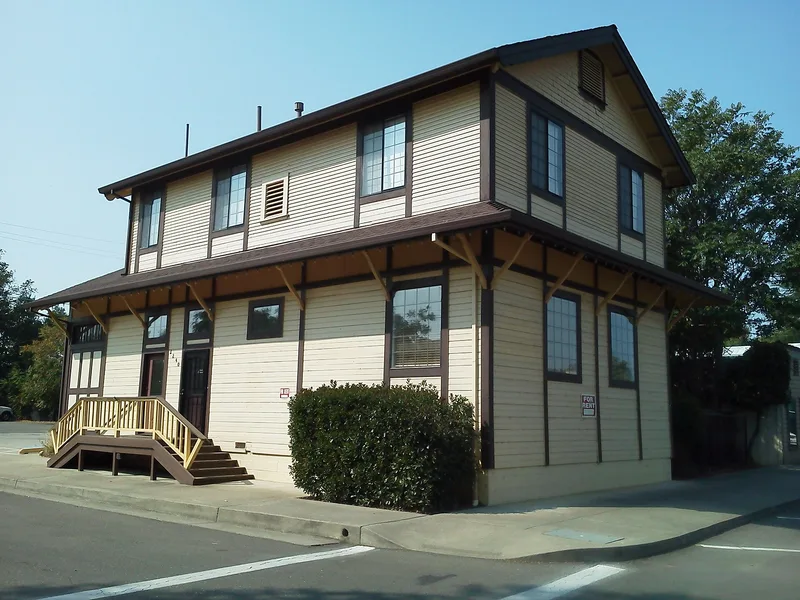
Cottonwood is a small Shasta County town whose historic core along Front Street survives much as it appeared in 1872. The community began in 1852 as a creekside store and ferry crossing for miners and settlers, then moved to its present site when the Southern Pacific Company bought land and built a depot while extending its line north toward Oregon. Front Street is unusually wide because teamsters needed room to turn wagons loaded with lumber and farm goods, and hitching rings remain on the high curbs. Several 19th-century brick buildings line the street, and the railroad depot, now used for storage, still faces it. Beyond Front Street, the old Cottonwood school, now a Grange Hall, and the old sanctuary of the First Baptist Church stand on Bush Street. Lumbering, farming, a flour mill, a creamery and a large electrical substation later supported the town, which became an important northern California shipping and trade center.
Machine-generated summary. This summary was generated by a language model from the official nomination document and has not been reviewed line by line by an editor. It may contain errors. Check the source document before relying on any detail. Source: nomination document (PDF) · catalog entry. Generated October 2026 (model claude-sonnet-5-5, prompt v1.0-2026-10-29).
| Period of significance | 19th Century (specific dates 1852; 1872) |
|---|---|
| Areas of significance | Commerce, Architecture |
| Acreage | 9 |
| Boundary source | not published |
| Full listing page | Cottonwood Historic District (property record) |
What listing means for this property
This is a historic district. Buildings within its boundary are either contributing (they add to the district's significance) or non-contributing. Owners of contributing income-producing buildings can claim the 20% federal rehabilitation tax credit; homeowners should look at state credits. National Register districts impose no design review by themselves; a local historic district ordinance, if one exists, does (the difference explained).
General information, not legal or tax advice. Rules change; confirm with your State Historic Preservation Office or a qualified adviser.