Carroll Avenue, 1300 Block

The National Park Service has not published a boundary polygon for this district; the map shows the listed properties inside it and the district's reference point.
Why it's listed
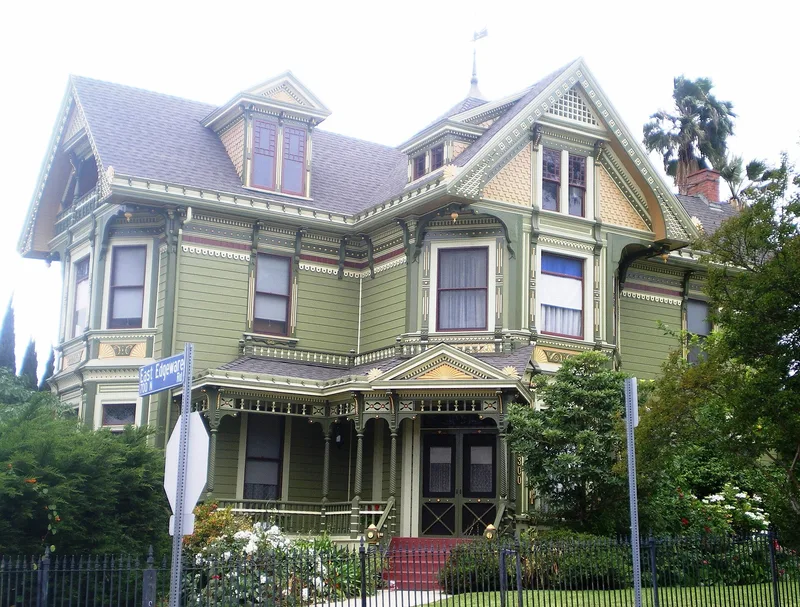
Carroll Avenue's 1300 block sits on a hilltop in Angelino Heights, overlooking downtown Los Angeles, and holds the largest surviving cluster of Victorian houses in the city. Nine two-story homes, eight built in 1887-1888 and one in 1895, show Eastlake and Queen Anne design, with spindlework, turrets, art glass and redwood interiors. One house, at 1330, was designed by architect Joseph Cather Newsom. Two Craftsman houses from shortly after 1900 and two small post-World War II stucco homes complete the block. The tract was recorded in 1886, at the start of the Los Angeles land boom, and developed as a solid, respectable suburb served by the Temple Street Cable Railway. Its residents appeared year after year in the city's Blue Book. Most Victorian buildings elsewhere in Los Angeles have been lost or stand isolated among modern apartment buildings, while this street kept its original setting. Each Victorian house is a city Historic-Cultural Monument, and restoration was in progress.
Machine-generated summary. This summary was generated by a language model from the official nomination document and has not been reviewed line by line by an editor. It may contain errors. Check the source document before relying on any detail. Source: nomination document (PDF) · catalog entry. Generated October 2026 (model claude-sonnet-5-5, prompt v1.0-2026-10-29).
| Styles | Victorian: Eastlake and Queen Anne, with two early 20th-century Craftsman houses |
|---|---|
| Areas of significance | Community Planning and Development, Architecture |
| Acreage | 6 |
| Boundary source | not published |
| Full listing page | Carroll Avenue, 1300 Block (property record) |
What listing means for this property
This is a historic district. Buildings within its boundary are either contributing (they add to the district's significance) or non-contributing. Owners of contributing income-producing buildings can claim the 20% federal rehabilitation tax credit; homeowners should look at state credits. National Register districts impose no design review by themselves; a local historic district ordinance, if one exists, does (the difference explained).
General information, not legal or tax advice. Rules change; confirm with your State Historic Preservation Office or a qualified adviser.