Campo de Cahuenga

The National Park Service has not published a boundary polygon for this district; the map shows the listed properties inside it and the district's reference point.
Why it's listed
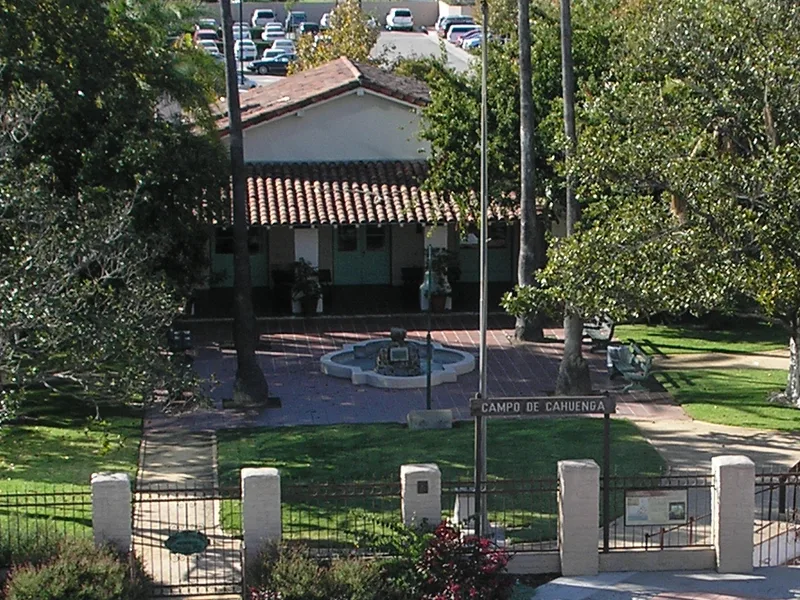
Campo de Cahuenga is a small public park on Lankershim Boulevard in North Hollywood that commemorates the signing of the Articles of Capitulation on January 13, 1847, which ended hostilities between Mexico and California. The grounds hold three main elements: the stone foundations and tile floors of an adobe built around 1795, a memorial building completed in 1950, and a courtyard-style landscape. Los Angeles architects Spencer and Landon designed the building as a Spanish Colonial Revival reconstruction, using a 1931 student excavation as their guide. The City of Los Angeles bought the lot in 1923 and dedicated the park in 1924, an early case of a city acquiring land to commemorate and preserve a historic site. Research has shown the adobe is older than long believed and was tied to Mission San Fernando. Today the building serves as a museum and meeting place, and an annual January reenactment recalls the signing.
Machine-generated summary. This summary was generated by a language model from the official nomination document and has not been reviewed line by line by an editor. It may contain errors. Check the source document before relying on any detail. Source: nomination document (PDF) · catalog entry. Generated October 2026 (model claude-sonnet-5-5, prompt v1.0-2026-10-29).
| Period of significance | Archeological site: 1795-1880s; Historic property: 1923-1953 |
|---|---|
| Styles | Spanish Colonial (Spanish Colonial Revival) |
| Areas of significance | Historic - Aboriginal, Historic - Non-Aboriginal, Architecture, Social History, Conservation |
| Acreage | 0.9 |
| Boundary source | not published |
| Full listing page | Campo de Cahuenga (property record) |
What listing means for this property
This is a historic district. Buildings within its boundary are either contributing (they add to the district's significance) or non-contributing. Owners of contributing income-producing buildings can claim the 20% federal rehabilitation tax credit; homeowners should look at state credits. National Register districts impose no design review by themselves; a local historic district ordinance, if one exists, does (the difference explained).
General information, not legal or tax advice. Rules change; confirm with your State Historic Preservation Office or a qualified adviser.