Bockius, Godfrey M., House

The National Park Service has not published a boundary polygon for this district; the map shows the listed properties inside it and the district's reference point.
Why it's listed
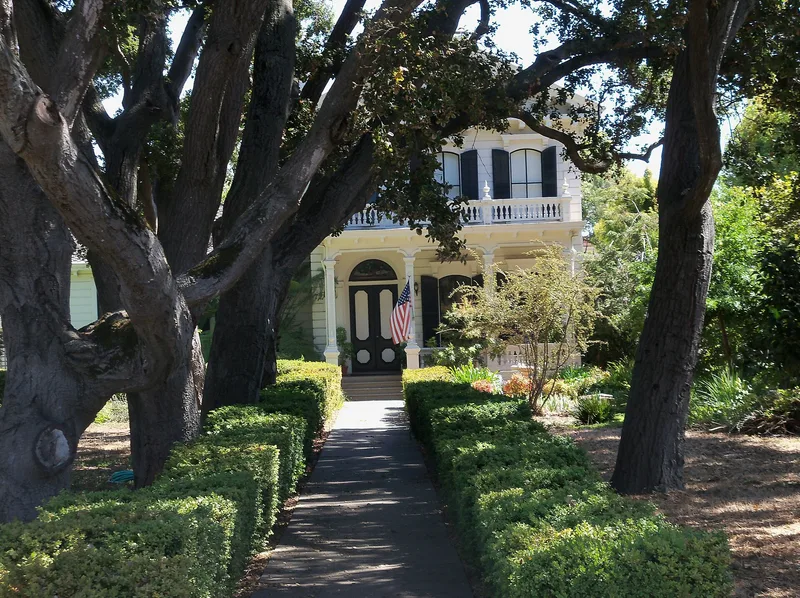
Built in 1870, this two-story wood-frame Italianate house on East Beach Street in Watsonville was the home of Godfrey M. Bockius, who developed a productive farm on part of the Rancho Bolsa de Pajaro. The house has drop siding, quoins, bracketed cornices, a front porch with a balcony, and arched four-pane windows with hoods and shutters. A one-story east wing, possibly an earlier farmhouse, was altered in 1948. The lot also holds an eight-sided tankhouse, a carriage house, a workmen's cottage, and an ornate stake fence leading to a walkway lined with boxwood and old oaks. Bockius was an experimental farmer, county judge, state assemblyman, first chairman of Watsonville's Board of Trustees, and president of the Bank of Watsonville. The property is recognized for his role in the town's agricultural, political and commercial life and as the best-preserved Italianate residence in the city, compared with the similar but compromised Rodgers House.
Machine-generated summary. This summary was generated by a language model from the official nomination document and has not been reviewed line by line by an editor. It may contain errors. Check the source document before relying on any detail. Source: nomination document (PDF) · catalog entry. Generated October 2026 (model claude-sonnet-5-5, prompt v1.0-2026-10-29).
| Period of significance | 1870-1905 |
|---|---|
| Styles | Italianate |
| Areas of significance | Commerce, Agriculture, Politics/Government, Architecture |
| Acreage | 1 |
| Boundary source | not published |
| Full listing page | Bockius, Godfrey M., House (property record) |
What listing means for this property
This is a historic district. Buildings within its boundary are either contributing (they add to the district's significance) or non-contributing. Owners of contributing income-producing buildings can claim the 20% federal rehabilitation tax credit; homeowners should look at state credits. National Register districts impose no design review by themselves; a local historic district ordinance, if one exists, does (the difference explained).
General information, not legal or tax advice. Rules change; confirm with your State Historic Preservation Office or a qualified adviser.