Great Sierra Mine Historic Site
Also known as: Dana Village

Why it's listed
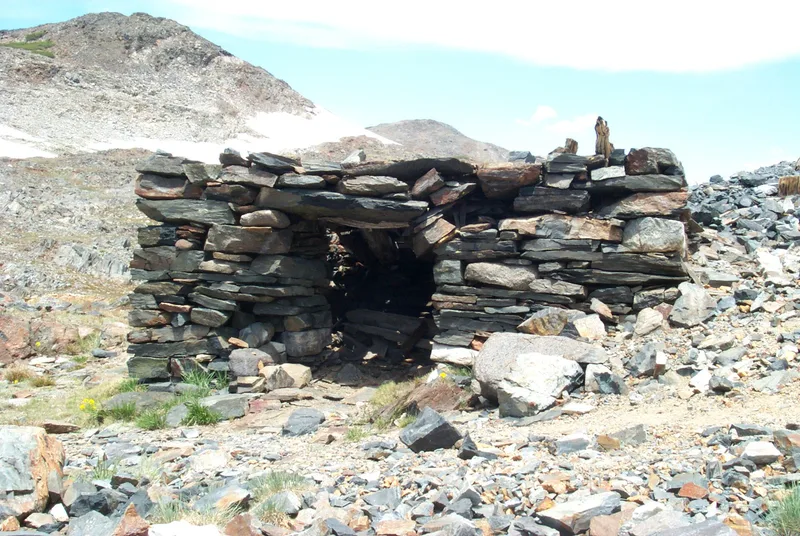
Dana Village was the mountaintop camp of the Great Sierra Mine, high on Tioga Hill above Gaylor Lake in what is now Yosemite National Park. The Great Sierra Consolidated Silver Mining Company bought up local claims in 1881 and set up the community, with a post office branch, to work the ground year-round. Living conditions at about 11,000 feet proved harsh, and the miners soon moved down to Bennettville. The company drove a tunnel 1,784 feet and spent over $300,000 before collapsing in 1884; a second effort in 1933 also failed to reach the legendary Sheepherder Lode. Remains include five stone cabins, a powder house and scattered blacksmith shop timbers. One cabin, built of mortarless schist or slate slabs with walls about four feet thick at the base, is the best preserved. The site was listed for its role in local mining history and for the rare masonry of that cabin.
Significance in brief: The nomination argues the site was the most intensive, though unprofitable, silver mining effort within the present Yosemite park boundary, giving it local significance in industry. One surviving cabin is locally significant architecturally for its rare dry-laid stone construction and high level of handcraftsmanship. The mining activity also fed the conservation debates that preceded the park's creation.
Machine-generated summary. This summary was generated by a language model from the official nomination document and has not been reviewed line by line by an editor. It may contain errors. Check the source document before relying on any detail. Source: nomination document (PDF) · National Archives catalog entry. NRHP reference 78000382, listed May 24, 1978. Summary generated October 2026 (model claude-sonnet-5-5, prompt v1.0-2026-10-29, confidence medium).
Key facts
| Address | W of Lee Vining in Yosemite National Park, Lee Vining |
|---|---|
| County | Tuolumne County |
| Listed | May 24, 1978 |
| Reference number | 78000382 |
| Resource type | District |
| Period of significance | 1881-1884 |
| Architect / builder | Great Sierra Consolidated Silver Co. |
| Areas of significance | Industry, Architecture |
| Level of significance | Local |
| Status (as stated in the nomination) | Ruins in fair condition: five stone cabins, a powder house and scattered blacksmith shop timbers remain. One cabin is relatively intact with its roof removed. Shafts are caved in, and mining equipment was moved to the Pioneer History Center at Wawona in the 1960s. |
| Acreage | 9.9 |
| Coordinates | 37.92750, -119.26913 (NPS GIS) |
What listing means for this property
This is a historic district. Buildings within its boundary are either contributing (they add to the district's significance) or non-contributing. Owners of contributing income-producing buildings can claim the 20% federal rehabilitation tax credit; homeowners should look at state credits. National Register districts impose no design review by themselves; a local historic district ordinance, if one exists, does (the difference explained).
Noted as vacant in the nomination. Nomination documents can be decades old; current status may differ. If you are considering buying an empty listed property, read the due-diligence checklist.
General information, not legal or tax advice. Rules change; confirm with your State Historic Preservation Office or a qualified adviser.
Sources and further reading
- National Park Service, National Register of Historic Places database (snapshot May 2026), reference 78000382.
- Nomination form (PDF, National Archives) — catalog entry
- Wikipedia article (used for cross-checking only; text not reproduced here)
- Wikidata Q5599961
- This listing as JSON
Last updated October 2026. Found an error? See the editorial policy for how to report it.