Cabin Creek Ranger Residence and Dormitory
Also known as: Cabin Creek Ranger Station, Buildings 65,66,319

Why it's listed
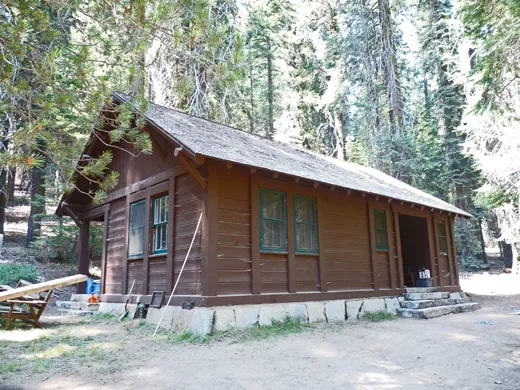
Set in dense conifer forest at about 6,800 feet in Sequoia National Park, these two wood-frame buildings face Cabin Creek. One is a three-room ranger residence; the other holds a two-room dormitory and a two-car garage. Civilian Conservation Corps enrollees built them during the summers of 1934 and 1935 to house entrance station rangers after the Generals Highway opened a new route into the park. They were designed in the National Park Service's San Francisco office under Thomas C. Vint. They were first planned for Lost Grove, but were moved to Cabin Creek to avoid congestion, and the exterior designs were reworked. Granite-veneered foundations, exposed timber framing, pole rafters, rustic siding, shingle roofs and a brown and green paint scheme let them blend with the trees. They were listed as well-executed examples of NPS rustic architecture, with local significance. Little has been altered, and the surrounding forest setting remains largely intact.
Significance in brief: The nomination argues local architectural significance as excellent examples of National Park Service rustic architecture, which stressed harmony between buildings and their natural setting. Native granite foundations, exposed framing, pole rafters, shingle roofs and a brown and green paint scheme help the buildings blend into the forest. They were also built to house entrance station rangers after the Generals Highway opened.
Machine-generated summary. This summary was generated by a language model from the official nomination document and has not been reviewed line by line by an editor. It may contain errors. Check the source document before relying on any detail. Source: nomination document (PDF) · National Archives catalog entry. NRHP reference 78000368, listed April 27, 1978. Summary generated October 2026 (model claude-sonnet-5-5, prompt v1.0-2026-10-29, confidence high).
Key facts
| Address | SE of Wilsonia on Generals Highway in Sequoia National Park, Wilsonia |
|---|---|
| County | Tulare County |
| Listed | April 27, 1978 |
| Reference number | 78000368 |
| Resource type | Building |
| Period of significance | 1934-35 |
| Architect / builder | National Park Service; designed by the NPS Branch of Plans and Design under Thomas C. Vint, with Harold G. Fowler and Lloyd Fletcher consulting; built by Civilian Conservation Corps enrollees from the Red Fir stub camp of the Buckeye CCC Camp |
| Architectural style | NPS rustic |
| Areas of significance | Architecture |
| Level of significance | Local |
| Status (as stated in the nomination) | Both buildings are in good condition apart from the roofs, which need reshingling and have decayed pole rafter ends; no significant alterations. The form marks the property as occupied. |
| Acreage | 0.7 |
| Coordinates | 36.64871, -118.81461 (NPS GIS) |
What listing means for this property
National Register listing is honorary for a privately owned home: it does not by itself restrict what an owner may do with their own money, and it does not require public access. Restrictions come from local landmark or historic-district ordinances, which are separate (how they differ).
Owner-occupied houses are not eligible for the 20% federal rehabilitation tax credit, which applies to income-producing buildings, but many states offer credits for homeowners. Listing also opens the door to preservation easements and to buying a plaque. Start with what listing means for homeowners, renovating a listed house and selling one.
General information, not legal or tax advice. Rules change; confirm with your State Historic Preservation Office or a qualified adviser.
Sources and further reading
- National Park Service, National Register of Historic Places database (snapshot May 2026), reference 78000368.
- Nomination form (PDF, National Archives) — catalog entry
- Wikipedia article (used for cross-checking only; text not reproduced here)
- Wikidata Q5015408
- This listing as JSON
Last updated October 2026. Found an error? See the editorial policy for how to report it.