Ash Mountain Entrance Sign
Also known as: Indian Head

Why it's listed
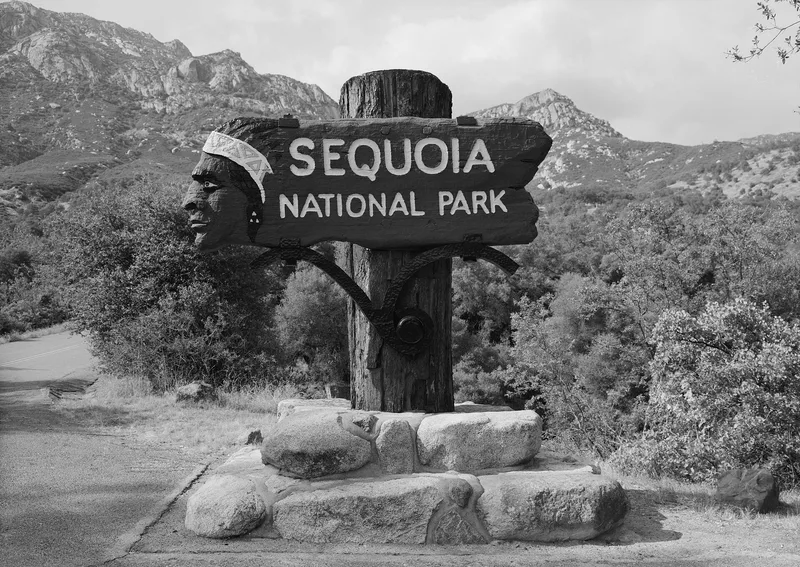
Visitors entering Sequoia National Park from the west pass a fifteen-foot monument made from a four-foot-diameter sequoia trunk set on a two-tiered boulder masonry platform. A carved sequoia-wood sign, about ten feet long, bears the legend "SEQUOIA NATIONAL PARK" and ends in the profile of the Cherokee Sequoyah. It was erected in the winter of 1935-1936. Park landscape architect Harold Fowler refined an earlier, smaller 1931 sign into this larger design, and Civilian Conservation Corps enrollee George Muno spent several months carving it from fallen sequoia wood, using chisels and hatchets. Other crews built the metal bracket, log pylon and masonry. The sign was moved about 100 yards in 1964 to make room for a new checking station, and it was later stained and painted. The nomination values it as monumental wood sculpture, as a product of the CCC, and as an example of 1930s National Park Service Rustic design using natural materials.
Significance in brief: The nomination argues local significance in art, landscape architecture and social/humanitarian terms. It is an example of monumental wood sculpture and of National Park Service Rustic design of the 1930s. Its creation by Civilian Conservation Corps enrollees links it to the CCC's contribution to park structures.
Machine-generated summary. This summary was generated by a language model from the official nomination document and has not been reviewed line by line by an editor. It may contain errors. Check the source document before relying on any detail. Source: nomination document (PDF) · National Archives catalog entry. NRHP reference 78000367, listed April 27, 1978. Summary generated October 2026 (model claude-sonnet-5-5, prompt v1.0-2026-10-29, confidence high).
Key facts
| Address | N of Three Rivers in Sequoia National Park, Three Rivers |
|---|---|
| County | Tulare County |
| Listed | April 27, 1978 |
| Reference number | 78000367 |
| Resource type | Object |
| Period of significance | 1935 |
| Architect / builder | George Muno/Harold Fowler |
| Architectural style | National Park Service Rustic |
| Areas of significance | Landscape Architecture, Art, Politics/Government, Social History |
| Level of significance | Local |
| Status (as stated in the nomination) | Moved about 100 yards in 1964 for a new checking station; stained and painted since the 1950s. The form states the relocation and minor alterations do not impair its significance. |
| Acreage | 0.1 |
| Coordinates | 36.48748, -118.83680 (NPS GIS) |
What listing means for this property
National Register listing is honorary: it recognises significance and does not restrict what a private owner may do without federal money or permits. It unlocks the 20% federal rehabilitation tax credit for income-producing buildings, state credits in many states, and Section 106 review when federal agencies are involved. See what listing means in practice.
General information, not legal or tax advice. Rules change; confirm with your State Historic Preservation Office or a qualified adviser.
Sources and further reading
- National Park Service, National Register of Historic Places database (snapshot May 2026), reference 78000367.
- Nomination form (PDF, National Archives) — catalog entry
- Wikipedia article (used for cross-checking only; text not reproduced here)
- Wikidata Q4804421
- This listing as JSON
Last updated October 2026. Found an error? See the editorial policy for how to report it.