Lewiston Historic District
Also known as: Lewiston
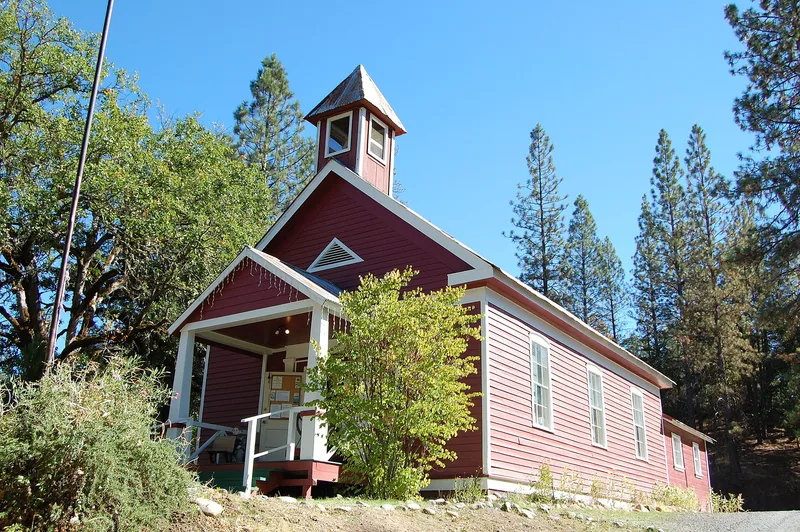

Why it's listed
Lewiston Historic District covers the old center of a gold mining town in northwestern Trinity County, California. A one-lane bridge over the Trinity River leads into the Deadwood and Turnpike Roads intersection, where the store, butcher shop and houses cluster. The district runs about half a mile and holds 16 contributing buildings and structures, plus a bridge. Gabled roofs, wood construction, board and batten siding and front verandas are common, with a few Greek Revival details. Lewiston was founded in 1853 on mining and ranching and became a supply, transport and news center for miners. Olney Phillips, who ran a toll bridge and ferry and built a house in 1875, is among the figures tied to its buildings. The period of significance ends around 1925, when the town declined. It revived only in the 1950s with Trinity Dam, and development shifted to a new town to the east, leaving the old center largely unchanged.
Significance in brief: The district is argued to be a very good example of a typical northern California mining town of the late 19th century. It is one of the earliest settlements in Trinity County and was a center for mining, commerce and transportation. Its simple, utilitarian buildings are linked to figures such as Olney Phillips.
Machine-generated summary. This summary was generated by a language model from the official nomination document and has not been reviewed line by line by an editor. It may contain errors. Check the source document before relying on any detail. Source: nomination document (PDF) · National Archives catalog entry. NRHP reference 88000550, listed April 17, 1989. Summary generated October 2026 (model claude-sonnet-5-5, prompt v1.0-2026-10-29, confidence medium).
Key facts
| Address | Roughly Deadwood, Turnpike, and Schoolhouse Rds., Lewiston |
|---|---|
| County | Trinity County |
| Listed | April 17, 1989 |
| Reference number | 88000550 |
| Resource type | District |
| Period of significance | 1860-1925 |
| Architect / builder | Multiple; examples include Olney Phillips (architect and builder of his 1875 house) and John Koll (builder of the 1899 Lewiston Hotel). |
| Architectural style | No style; Greek Revival details; vernacular |
| Criteria |
|
| Areas of significance | Commerce, Transportation, Architecture |
| Level of significance | Local |
| Status (as stated in the nomination) | Most contributors are described as in good condition with moderately high integrity. Several buildings are still in commercial, residential, school and community use, such as the hotel restaurant. |
| Acreage | 15 |
| Coordinates | 40.70836, -122.80585 (NPS GIS) |
What listing means for this property
This is a historic district. Buildings within its boundary are either contributing (they add to the district's significance) or non-contributing. Owners of contributing income-producing buildings can claim the 20% federal rehabilitation tax credit; homeowners should look at state credits. National Register districts impose no design review by themselves; a local historic district ordinance, if one exists, does (the difference explained).
General information, not legal or tax advice. Rules change; confirm with your State Historic Preservation Office or a qualified adviser.
Sources and further reading
- National Park Service, National Register of Historic Places database (snapshot May 2026), reference 88000550.
- Nomination form (PDF, National Archives) — catalog entry
- Wikipedia article (used for cross-checking only; text not reproduced here)
- Wikidata Q49516329
- This listing as JSON
Last updated October 2026. Found an error? See the editorial policy for how to report it.