Live Oak Historic Commercial District

Why it's listed
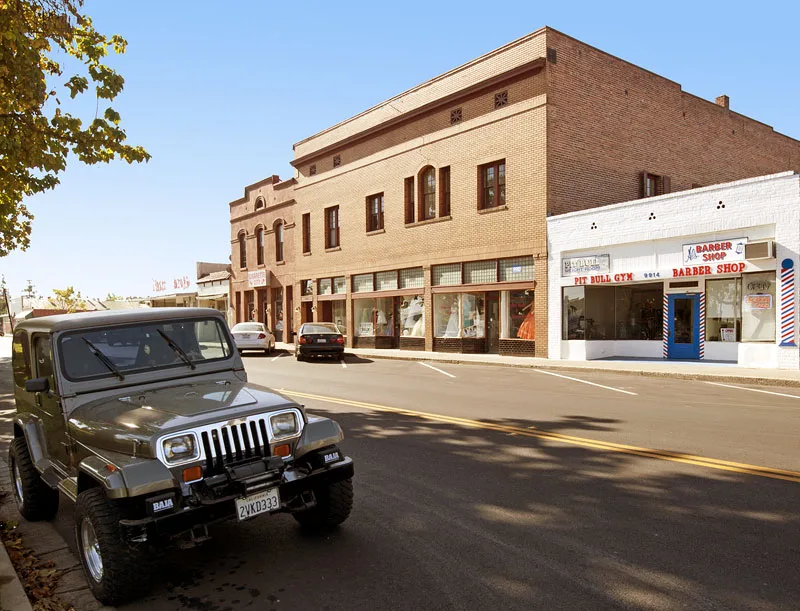
Live Oak's historic commercial district occupies Broadway and Fir Street in the city's downtown, with a railroad parcel on the east side of Broadway. It contains twelve buildings and a row of palm trees, nine of which contribute to its historic character. The oldest building is Live Oak Hall, dating from about 1875, with retail space below and a community meeting room above. Other contributors include a 1913 bank branch, 1920s brick stores and a bakery building, a 1882 railroad depot, and a wood warehouse. Palms planted around 1900 link the depot and warehouse visually. The district developed after the Southern Pacific Railroad laid tracks in 1869 and made Live Oak the main shipping point in Sutter County. It is the only surviving group of pre-1930 commercial buildings in the city. Some demolitions and several vacant, boarded buildings have affected it, but the area still closely resembles its 1930 appearance.
Significance in brief: The district is the city's only collection of commercial buildings built before 1930 and reflects the growth of local commerce from the 1870s to the start of the Great Depression. It is closely tied to the arrival of the Southern Pacific Railroad and early retail business. It retains a high degree of integrity despite some demolitions and neglect.
Machine-generated summary. This summary was generated by a language model from the official nomination document and has not been reviewed line by line by an editor. It may contain errors. Check the source document before relying on any detail. Source: nomination document (PDF) · National Archives catalog entry. NRHP reference 97001657, listed January 23, 1998. Summary generated October 2026 (model claude-sonnet-5-5, prompt v1.0-2026-10-29, confidence high).
Key facts
| Address | Along Broadway between Pennington Rd. and Elm St., Live Oak |
|---|---|
| County | Sutter County |
| Listed | January 23, 1998 |
| Reference number | 97001657 |
| Resource type | District |
| Period of significance | 1875-1930 |
| Architect / builder | Unknown |
| Architectural style | Late 19th and 20th Century Revivals: Classical Revival; Late Victorian: Italianate; Late 19th and 20th Century Revivals: Mission/Spanish Colonial Revival |
| Criteria |
|
| Areas of significance | Commerce |
| Level of significance | Local |
| Status (as stated in the nomination) | Many contributing buildings are in poor condition with boarded doors and windows; five of seven buildings are described as vacant, and two important buildings are slated for rehabilitation. Current use listed as specialty store, warehouse and vacant/not in use. |
| Acreage | 8.8 |
| Coordinates | 39.27497, -121.66175 (NPS GIS) |
What listing means for this property
This is a historic district. Buildings within its boundary are either contributing (they add to the district's significance) or non-contributing. Owners of contributing income-producing buildings can claim the 20% federal rehabilitation tax credit; homeowners should look at state credits. National Register districts impose no design review by themselves; a local historic district ordinance, if one exists, does (the difference explained).
Noted as vacant in the nomination. Nomination documents can be decades old; current status may differ. If you are considering buying an empty listed property, read the due-diligence checklist.
General information, not legal or tax advice. Rules change; confirm with your State Historic Preservation Office or a qualified adviser.
Sources and further reading
- National Park Service, National Register of Historic Places database (snapshot May 2026), reference 97001657.
- Nomination form (PDF, National Archives) — catalog entry
- Wikipedia article (used for cross-checking only; text not reproduced here)
- Wikidata Q6655352
- This listing as JSON
Last updated October 2026. Found an error? See the editorial policy for how to report it.