First National Bank of Oakdale Building

Why it's listed
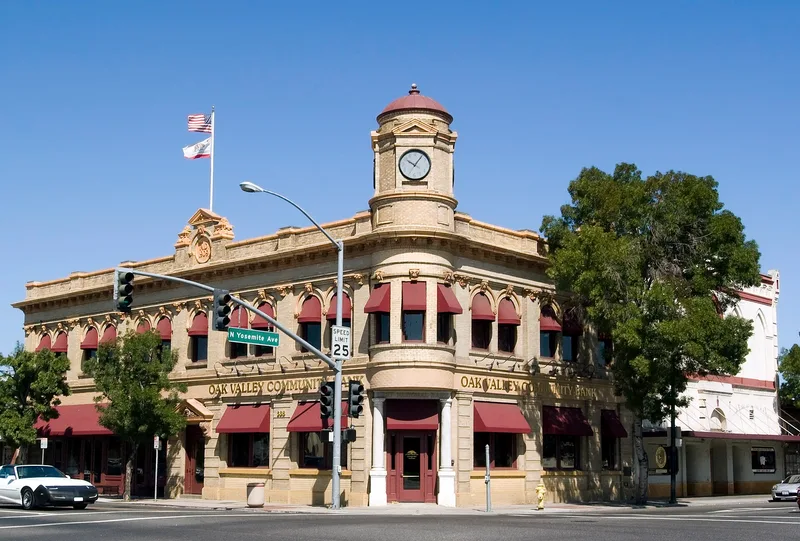
Completed in 1909, this two-story yellow brick bank building anchors the entrance to downtown Oakdale, California. Its two wings, along F Street and Yosemite Avenue, meet at a round clock tower with a domed roof and a Seth Thomas clock. The Romanesque design shows influence from Richardsonian landmarks and from classical buildings that followed the 1893 Chicago World's Fair. Arched second-floor windows, terra-cotta keystones, a bracketed cornice and two small pediments, one dated 1909, decorate the exterior. The bank was founded in 1904 by brothers Edward and William Rodden, who had earlier run a general store. Its loans supported irrigated farms, the Pacific Pea Packing Company, ranching, and several downtown buildings, and the bank outlasted the Depression. The Rodden family sold it in 1948, and the bank left the building in 1955. Today the city owns it, and most of it is vacant apart from two small shops on the first floor.
Significance in brief: The nomination argues the building was at the center of Oakdale's 20th-century development under Criterion A (Economics). The bank financed farms, the canning industry, ranching and downtown construction, and it survived the Depression. The building also retains its integrity as a landmark at the entrance to downtown.
Machine-generated summary. This summary was generated by a language model from the official nomination document and has not been reviewed line by line by an editor. It may contain errors. Check the source document before relying on any detail. Source: nomination document (PDF) · National Archives catalog entry. NRHP reference 00000320, listed April 6, 2000. Summary generated October 2026 (model claude-sonnet-5-5, prompt v1.0-2026-10-29, confidence high).
Key facts
| Address | 338 East F St., Oakdale |
|---|---|
| County | Stanislaus County |
| Listed | April 6, 2000 |
| Reference number | 00000320 |
| Resource type | Building |
| Period of significance | 1909-1948 |
| Architect / builder | Rodden, Edward; Rodden, William |
| Architectural style | Romanesque |
| Criteria |
|
| Areas of significance | Economics |
| Level of significance | Local |
| Status (as stated in the nomination) | Mostly vacant; two small stores occupy part of the first floor. The city owns it and plans to seek a developer to rehabilitate and reuse it. |
| Acreage | 0.1 |
| Coordinates | 37.76691, -120.84770 (NPS GIS) |
What listing means for this property
For an income-producing building, listing (individually or as a contributing building in a district) is the gateway to the 20% federal rehabilitation tax credit on qualified rehabilitation costs, often stackable with state credits. Work claiming the credit must follow the Secretary of the Interior's Standards and be approved in advance.
Listing does not restrict a private owner acting without federal money or permits; where federal funding or licensing is involved, Section 106 review applies.
Noted as vacant in the nomination. Nomination documents can be decades old; current status may differ. If you are considering buying an empty listed property, read the due-diligence checklist.
General information, not legal or tax advice. Rules change; confirm with your State Historic Preservation Office or a qualified adviser.
Sources and further reading
- National Park Service, National Register of Historic Places database (snapshot May 2026), reference 00000320.
- Nomination form (PDF, National Archives) — catalog entry
- Wikidata Q133554747
- This listing as JSON
Last updated October 2026. Found an error? See the editorial policy for how to report it.