Sweet House

Why it's listed
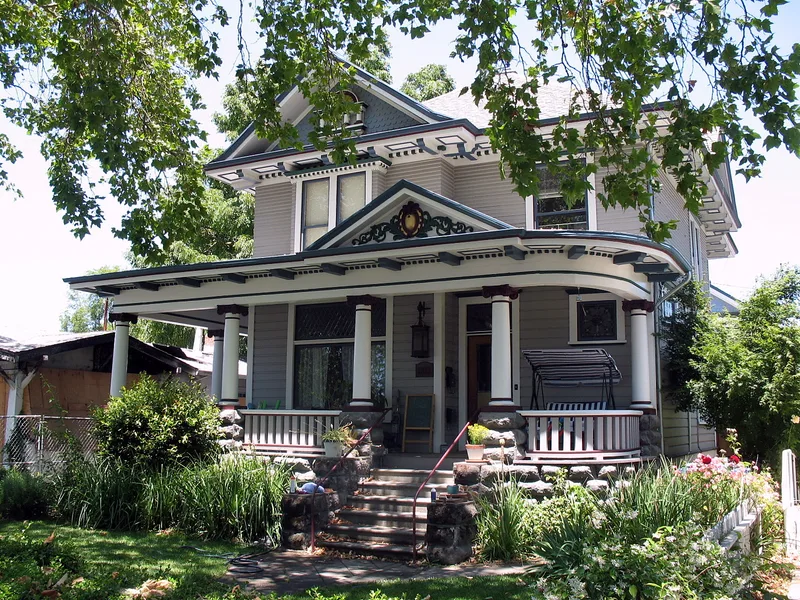
Located at 607 Cherry Street in Santa Rosa, this hip-roofed Queen Anne house was completed in June 1886 on a lot in the Sacry Addition. After the 1906 earthquake damaged it, the exterior and interior were remodeled in 1907 for James and Julia Sweet, adding a wrap-around porch with Ionic columns, a raised cement block foundation, dormers with dentil detailing, leaded and colored glass, and two brick fireplaces. The Sweets bought the house in 1894 and lived there until Julia's death in 1954. James Sweet founded the Santa Rosa Business College, wrote business textbooks used across the western states, and served as mayor from 1898 to 1902, supporting the municipal water system and other civic reforms. Julia Sweet led religious, social and political activities locally and statewide. The house is well maintained and counts as a contributor to the proposed Cherry Street Historic District, though its main importance lies in its link to the Sweets.
Significance in brief: The house is significant for its association with James S. Sweet, founder of the Santa Rosa Business College, textbook author and two-term mayor of Santa Rosa, and his wife Julia Goodyear Sweet, a leader in religious, social and political activities. The Sweets lived there from 1894 until Julia's death in 1954. It is also a contributor to the proposed Cherry Street Historic District.
Machine-generated summary. This summary was generated by a language model from the official nomination document and has not been reviewed line by line by an editor. It may contain errors. Check the source document before relying on any detail. Source: nomination document (PDF) · National Archives catalog entry. NRHP reference 87002415, listed January 14, 1988. Summary generated October 2026 (model claude-sonnet-5-5, prompt v1.0-2026-10-29, confidence medium).
Key facts
| Address | 607 Cherry St., Santa Rosa |
|---|---|
| County | Sonoma County |
| Listed | January 14, 1988 |
| Reference number | 87002415 |
| Resource type | Building |
| Period of significance | 1894-1937 |
| Architect / builder | unknown (the form suggests it was likely built by contractor Thomas J. Ludwig) |
| Architectural style | Queen Anne with Period Revival details |
| Areas of significance | Education, Politics/Government, Architecture, Social History |
| Level of significance | Local |
| Status (as stated in the nomination) | Described as in excellent condition and well maintained, with commercial use since 1974; the form says it has not been altered since 1907. |
| Acreage | 0.1 |
| Coordinates | 38.44480, -122.71657 (NPS GIS) |
What listing means for this property
National Register listing is honorary for a privately owned home: it does not by itself restrict what an owner may do with their own money, and it does not require public access. Restrictions come from local landmark or historic-district ordinances, which are separate (how they differ).
Owner-occupied houses are not eligible for the 20% federal rehabilitation tax credit, which applies to income-producing buildings, but many states offer credits for homeowners. Listing also opens the door to preservation easements and to buying a plaque. Start with what listing means for homeowners, renovating a listed house and selling one.
General information, not legal or tax advice. Rules change; confirm with your State Historic Preservation Office or a qualified adviser.
Sources and further reading
- National Park Service, National Register of Historic Places database (snapshot May 2026), reference 87002415.
- Nomination form (PDF, National Archives) — catalog entry
- Wikidata Q133554640
- This listing as JSON
Last updated October 2026. Found an error? See the editorial policy for how to report it.