Crooks Mansion

Why it's listed
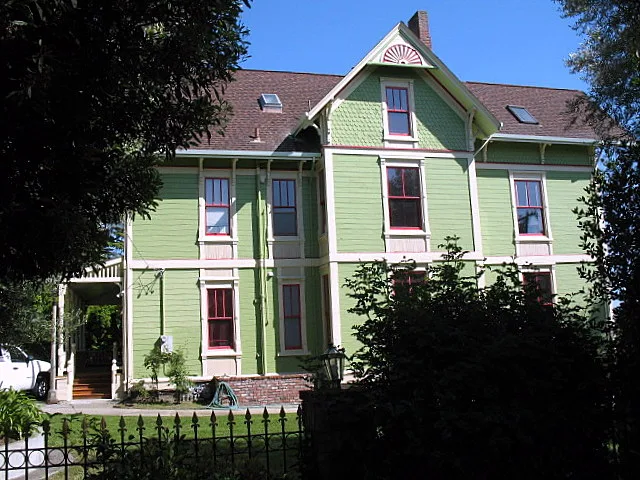
Overlooking the Carquinez Straits from a bluff in Benicia, this three-story house of seventeen rooms was built around 1880 and is described as primarily Eastlake-Stick in style, with some Shingle detail. Fish-scale shingles, carved sunbursts, pilasters, brackets and squared bay windows mark its character. The Crooks family owned it for about three quarters of a century, so it remains largely unaltered, and more than half of its well over one hundred windows still hold original pressed glass. William Crooks, who bought it from his brother, served as Benicia's mayor for decades, led the People's Bank of Benicia and built the Majestic Theatre. An architectural guide to Northern California lists the house, and a reviewer called it one of the last Eastlake examples in Benicia. The grounds keep traces of a Victorian garden with exotic trees, and nearby burial and artifact finds suggest possible archaeological value.
Significance in brief: The nomination argues significance on three grounds: its long occupation by the Crooks family, including William Crooks, a longtime mayor and banker; its architecture as one of the few remaining Eastlake-style houses in Benicia; and its grounds, which preserve remnants of a Victorian garden. It also notes possible archaeological importance, since Native American burial and artifact finds have occurred nearby.
Machine-generated summary. This summary was generated by a language model from the official nomination document and has not been reviewed line by line by an editor. It may contain errors. Check the source document before relying on any detail. Source: nomination document (PDF) · National Archives catalog entry. NRHP reference 78000795, listed November 14, 1978. Summary generated October 2026 (model claude-sonnet-5-5, prompt v1.0-2026-10-29, confidence medium).
Key facts
| Address | 285 W. G St., Benicia |
|---|---|
| County | Solano County |
| Listed | November 14, 1978 |
| Reference number | 78000795 |
| Resource type | Building |
| Architectural style | Eastlake-Stick, with some Shingle style detail |
| Areas of significance | Historic - Aboriginal, Politics/Government, Architecture |
| Level of significance | Local |
| Status (as stated in the nomination) | Occupied as a private residence; extensively restored. The house stood unoccupied and was vandalized in the early 1970s. |
| Acreage | 0.6 |
| Coordinates | 38.05182, -122.16222 (NPS GIS) |
What listing means for this property
National Register listing is honorary for a privately owned home: it does not by itself restrict what an owner may do with their own money, and it does not require public access. Restrictions come from local landmark or historic-district ordinances, which are separate (how they differ).
Owner-occupied houses are not eligible for the 20% federal rehabilitation tax credit, which applies to income-producing buildings, but many states offer credits for homeowners. Listing also opens the door to preservation easements and to buying a plaque. Start with what listing means for homeowners, renovating a listed house and selling one.
General information, not legal or tax advice. Rules change; confirm with your State Historic Preservation Office or a qualified adviser.
Sources and further reading
- National Park Service, National Register of Historic Places database (snapshot May 2026), reference 78000795.
- Nomination form (PDF, National Archives) — catalog entry
- Wikidata Q133545019
- This listing as JSON
Last updated October 2026. Found an error? See the editorial policy for how to report it.