Sierra County Sheriff's Gallows

Why it's listed
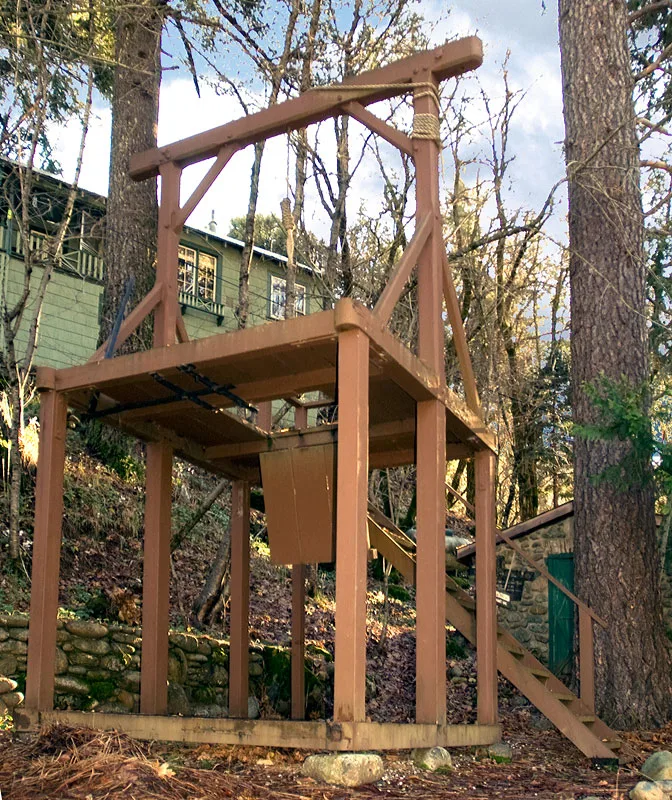
Beside the Sierra County Courthouse in Downieville stands a wooden gallows built in 1885 for a single purpose: the hanging of 20-year-old James O'Neill, convicted of killing John Woodward at Webber Lake. Local carpenters erected it a day before the execution, and it was held together with wooden pegs in mortise and tenon joints so it could be taken apart and stored. It was never used again. A 1891 change in state law moved executions to state prisons, and hanging ended altogether in 1941. The gallows sat forgotten in the old courthouse attic until 1927, was re-erected, moved, and settled at its present site in 1933. After years of decay, a 1988 restoration returned it to its 1885 appearance. It is described as the only authentic standing gallows in California, and it is a registered state historical landmark.
Significance in brief: The nomination argues it is significant for its link to a period when California counties carried out capital punishment locally. It is also valued as a rare surviving gallows, and the only authentic standing example in the state. It was used once, in the 1885 hanging of James O'Neill, the last legal execution in Sierra County. The form also credits it as a representative of the architectural and craftsmen abilities of its period.
Machine-generated summary. This summary was generated by a language model from the official nomination document and has not been reviewed line by line by an editor. It may contain errors. Check the source document before relying on any detail. Source: nomination document (PDF) · National Archives catalog entry. NRHP reference 90000118, listed February 15, 1990. Summary generated October 2026 (model claude-sonnet-5-5, prompt v1.0-2026-10-29, confidence high).
Key facts
| Address | Galloway Rd. and Courthouse Sq., Downieville |
|---|---|
| County | Sierra County |
| Listed | February 15, 1990 |
| Reference number | 90000118 |
| Resource type | Structure |
| Period of significance | 1885 |
| Architectural style | No style |
| Areas of significance | Law, Architecture |
| Level of significance | State |
| Status (as stated in the nomination) | Restored in 1988 to its 1885 appearance with a new stone foundation, retaining walls and metal bracing; the trapdoor mechanism is functional. The form lists its current function as vacant, not in use. |
| Acreage | 0.9 |
| Coordinates | 39.55823, -120.83050 (NPS GIS) |
What listing means for this property
National Register listing is honorary: it recognises significance and does not restrict what a private owner may do without federal money or permits. It unlocks the 20% federal rehabilitation tax credit for income-producing buildings, state credits in many states, and Section 106 review when federal agencies are involved. See what listing means in practice.
Noted as vacant in the nomination. Nomination documents can be decades old; current status may differ. If you are considering buying an empty listed property, read the due-diligence checklist.
General information, not legal or tax advice. Rules change; confirm with your State Historic Preservation Office or a qualified adviser.
Sources and further reading
- National Park Service, National Register of Historic Places database (snapshot May 2026), reference 90000118.
- Nomination form (PDF, National Archives) — catalog entry
- Wikipedia article (used for cross-checking only; text not reproduced here)
- Wikidata Q65086452
- This listing as JSON
Last updated October 2026. Found an error? See the editorial policy for how to report it.