Pigeon Point Lighthouse

Why it's listed
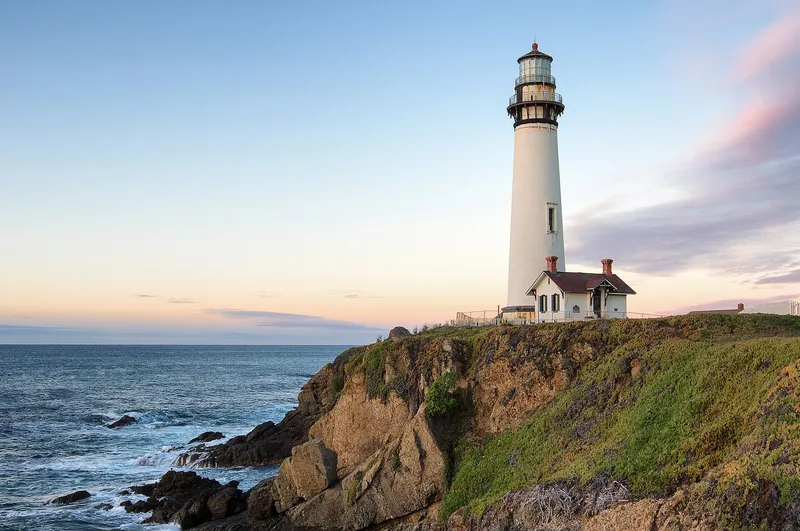
Pigeon Point Lighthouse is a 100-foot brick tower on a rocky cliff about fifty feet above the Pacific, halfway between Half Moon Bay and Santa Cruz. Construction began in 1871 under builder Phineas F. Marston, to plans signed by the Light House Board, and the light first shone on 15 November 1872. Shipwrecks along the fog-bound coast prompted its creation. The tower has an octagonal base, a conical shaft with cut-stone window trim, a cast-iron gallery and a brass-and-copper lantern. A brick watch house in Eastlake or Cottage style is attached. The first-order Fresnel lens, made in Paris and earlier used at Cape Hatteras, still sits in the lantern. The tower has needed no structural changes and has weathered earthquakes and storms without damage. A 1908 fog signal building and carpenter shop and a 1909 oil house are included in the district. The nomination praises it as an excellent example of a working lighthouse in a largely unchanged setting.
Significance in brief: The nomination calls it the most beautiful and best architectural lighthouse on the Pacific Coast, an excellent example of a mid-nineteenth-century classic lighthouse. It has served continuously for over a century with its original first-order Fresnel lens. It was a powerful coastal light for shipping, and the tower plan was a type not otherwise used on the West Coast.
Machine-generated summary. This summary was generated by a language model from the official nomination document and has not been reviewed line by line by an editor. It may contain errors. Check the source document before relying on any detail. Source: nomination document (PDF) · National Archives catalog entry. NRHP reference 77000337, listed March 8, 1977. Summary generated October 2026 (model claude-sonnet-5-5, prompt v1.0-2026-10-29, confidence medium).
Key facts
| Address | S of Pescadero at Pigeon Point off CA 1, Pescadero |
|---|---|
| County | San Mateo County |
| Listed | March 8, 1977 |
| Reference number | 77000337 |
| Resource type | District |
| Period of significance | 1800-1899 and 1900 (specific dates 1871-1873) |
| Architect / builder | Phineas F. Marston (builder/architect); drawings signed by George H. Elliot, Major of Engineers, Light House Board; ironwork cast by Nutting & Son, San Francisco |
| Architectural style | Italianate (tower); watch house in restrained Eastlake or Cottage style |
| Areas of significance | Commerce, Military, Engineering, Transportation, Politics/Government, Architecture |
| Level of significance | National |
| Status (as stated in the nomination) | Occupied and in active service as a lighthouse, automated in February 1974 with an aero beacon added; the lens remains in place; condition excellent and unaltered. The 1870s keeper's house was demolished in 1960. |
| Acreage | 4.3 |
| Coordinates | 37.18171, -122.39365 (NPS GIS) |
What listing means for this property
This is a historic district. Buildings within its boundary are either contributing (they add to the district's significance) or non-contributing. Owners of contributing income-producing buildings can claim the 20% federal rehabilitation tax credit; homeowners should look at state credits. National Register districts impose no design review by themselves; a local historic district ordinance, if one exists, does (the difference explained).
General information, not legal or tax advice. Rules change; confirm with your State Historic Preservation Office or a qualified adviser.
Sources and further reading
- National Park Service, National Register of Historic Places database (snapshot May 2026), reference 77000337.
- Nomination form (PDF, National Archives) — catalog entry
- Wikipedia article (used for cross-checking only; text not reproduced here)
- Wikidata Q7193314
- This listing as JSON
Last updated October 2026. Found an error? See the editorial policy for how to report it.