Piedras Blancas Light Station

Why it's listed
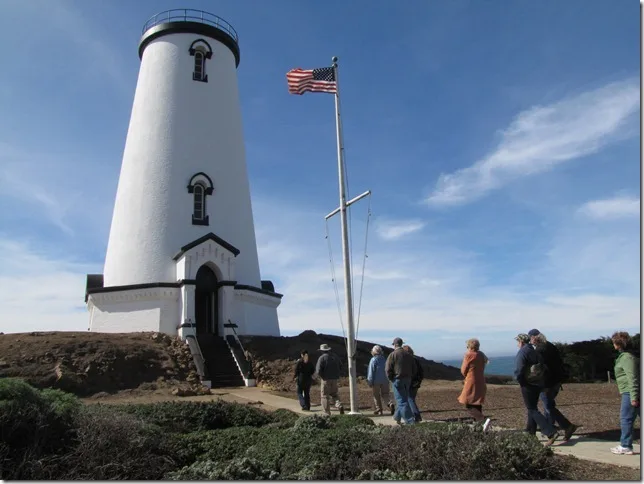
Piedras Blancas Light Station sits on a rocky knoll beside Highway 1 at the northern entrance to San Simeon Bay. Its 70-foot white-painted brick tower was built in 1875, and a brick fog-signal building and a concrete oil house followed in 1906. The station was established to aid coastal trade, since no lighthouse then stood on the 145 miles of coast between Point Pinos and Point Conception. The 1868 wreck of the Harlech Castle helped prompt its construction. A storm in 1949 destroyed the tower's lantern room and the original Fresnel lens, which is now displayed in Cambria. Even so, the tower retains elaborate Gothic brick and stone work, massive paneled doors and an interior cast iron stairway. The fog-signal building blends Romanesque Revival and Neo-Classical details, which is unusual for a utilitarian structure. A modern light still operates, and the grounds serve as a wildlife research station. The listed district counts three contributing resources and eight non-contributing ones.
Significance in brief: The station is significant under Criteria A and C. It reflects California's reliance on coastal shipping and navigation aids, and it holds outstanding examples of late 19th and early 20th century architecture. The tower is described as the most ornately Gothic lighthouse built in California, and the fog-signal building as arguably the most architecturally interesting of its type in the state.
Machine-generated summary. This summary was generated by a language model from the official nomination document and has not been reviewed line by line by an editor. It may contain errors. Check the source document before relying on any detail. Source: nomination document (PDF) · National Archives catalog entry. NRHP reference 91001095, listed September 3, 1991. Summary generated October 2026 (model claude-sonnet-5-5, prompt v1.0-2026-10-29, confidence high).
Key facts
| Address | CA 1 on Point Piedras Blancas, San Simeon |
|---|---|
| County | San Luis Obispo County |
| Listed | September 3, 1991 |
| Reference number | 91001095 |
| Resource type | District |
| Period of significance | 1875-1940 |
| Architect / builder | Captain Ashley, builder. |
| Architectural style | Victorian Gothic; Neo Classical; Romanesque Revival |
| Criteria |
|
| Areas of significance | Commerce, Transportation, Architecture, Maritime History |
| Level of significance | State |
| Status (as stated in the nomination) | The tower still carries a modern navigation light. The rest of the site is used as a biological research station and for institutional housing. The tower lost its lantern room in a 1949 storm. |
| Acreage | 20 |
| Coordinates | 35.66633, -121.28477 (NPS GIS) |
What listing means for this property
This is a historic district. Buildings within its boundary are either contributing (they add to the district's significance) or non-contributing. Owners of contributing income-producing buildings can claim the 20% federal rehabilitation tax credit; homeowners should look at state credits. National Register districts impose no design review by themselves; a local historic district ordinance, if one exists, does (the difference explained).
General information, not legal or tax advice. Rules change; confirm with your State Historic Preservation Office or a qualified adviser.
Sources and further reading
- National Park Service, National Register of Historic Places database (snapshot May 2026), reference 91001095.
- Nomination form (PDF, National Archives) — catalog entry
- Wikipedia article (used for cross-checking only; text not reproduced here)
- Wikidata Q7191571
- This listing as JSON
Last updated October 2026. Found an error? See the editorial policy for how to report it.