Irvine Park

Why it's listed
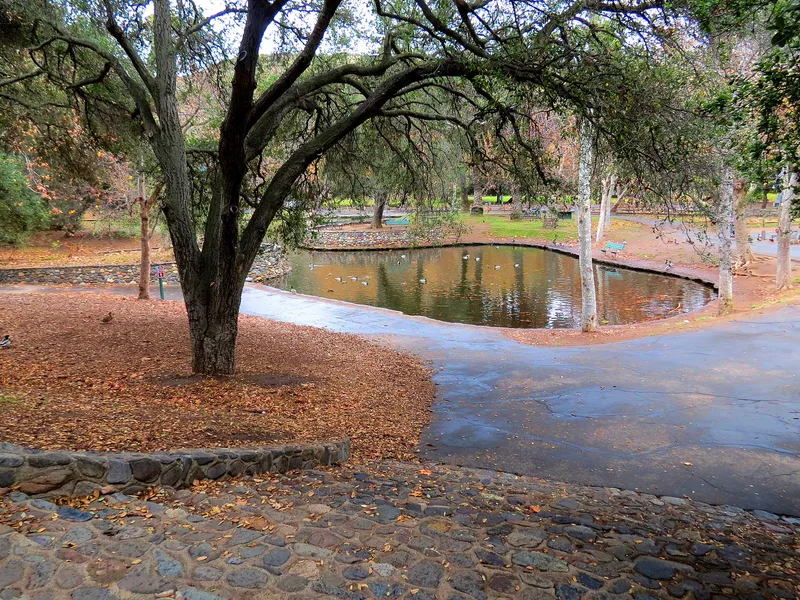
Irvine Park, in Santiago Canyon east of Orange, California, is a county park that grew out of a favorite pioneer picnic grove. James Irvine Jr. gave the 160-acre site to Orange County in 1897 on the condition that it stay natural-looking and that its oaks receive full care, making it the county's first regional park. Some live oaks are estimated at 700 years old. Most of the park's present character dates from 1919 to 1936. A lake and boat house were added in 1913-14, and architect Frederick Eley designed Craftsman-style buildings with shingle siding, tile roofs and river-rock piers, including an exhibit hall, a restaurant and a drinking fountain. Works Progress Administration crews built rock fireplaces, sinks and retaining walls in 1935-1936. A cannon, a Spanish-American War memorial and an Indian mortar rock add to the grounds. During World War II the park served briefly as a military training camp. Restoration was under way when the park was listed.
Significance in brief: It is Orange County's first regional park, on land donated by the Irvine family, and a long-popular picnic ground since the late 1850s. It keeps 1930s Craftsman-style park buildings designed by Frederick Eley, Santa Ana's first registered architect, plus Works Progress Administration stonework from 1935-1936. Ancient live oaks and the creek setting retain the park's historic feeling.
Machine-generated summary. This summary was generated by a language model from the official nomination document and has not been reviewed line by line by an editor. It may contain errors. Check the source document before relying on any detail. Source: nomination document (PDF) · National Archives catalog entry. NRHP reference 83001215, listed April 7, 1983. Summary generated October 2026 (model claude-sonnet-5-5, prompt v1.0-2026-10-29, confidence high).
Key facts
| Address | 21401 Chapman Ave., Orange |
|---|---|
| County | Orange County |
| Listed | April 7, 1983 |
| Reference number | 83001215 |
| Resource type | Site |
| Period of significance | 1919-1936 |
| Architect / builder | Frederick Eley |
| Architectural style | Craftsman (with a Mission Revival restroom) |
| Areas of significance | Entertainment/Recreation, Architecture |
| Level of significance | Local |
| Status (as stated in the nomination) | Under rehabilitation at the time of nomination; the lake was temporarily dry and buildings were being restored, with about 400,000 visitors a year. The park is publicly owned. |
| Acreage | 160 |
| Coordinates | 33.79526, -117.74845 (NPS GIS) |
What listing means for this property
Sites (archaeological sites, battlefields, landscapes) are often listed with a restricted address to protect them from looting or disturbance. Listing is honorary for private owners; federal undertakings on or near the site go through Section 106 review, and state laws may protect burials and artefacts regardless of listing.
General information, not legal or tax advice. Rules change; confirm with your State Historic Preservation Office or a qualified adviser.
Sources and further reading
- National Park Service, National Register of Historic Places database (snapshot May 2026), reference 83001215.
- Nomination form (PDF, National Archives) — catalog entry
- Wikipedia article (used for cross-checking only; text not reproduced here)
- Wikidata Q6074361
- This listing as JSON
Last updated October 2026. Found an error? See the editorial policy for how to report it.