Huntington Beach Municipal Pier

Why it's listed
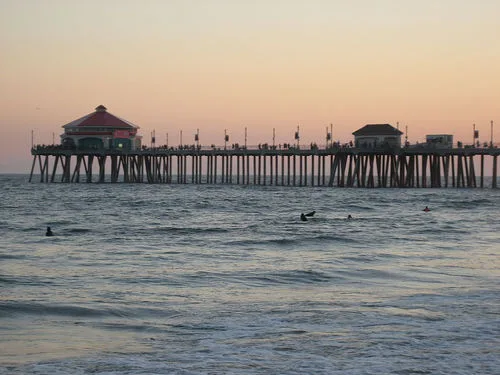
Huntington Beach Municipal Pier reaches into the Pacific at the foot of Main Street. It was built in 1914 to replace a wooden pier damaged by storms, as part of an effort to make the city a major West Coast resort. Designed by Ernest Rothenberg and built by the Mercereau Bridge Company of Los Angeles, it was billed as the longest, highest and most artistically designed solid concrete municipal pier in the world. Reinforced concrete pilings were experimental at the time, since it was unknown how well they would resist seawater. Decorative touches include a recessed-panel balustrade and flared piling tops. In 1930 the pier was lengthened to 1,804 feet and five Art Deco buildings were added on its tees. Storms, including one in January 1988, removed sections, but about 84 percent of the original length, the 1914 cornerstone and three of the Art Deco buildings survive. The nomination finds it significant for its role in the city's growth and as the last surviving recreational concrete pier of its era in Southern California.
Significance in brief: The nomination argues it helped establish Huntington Beach as a major West Coast resort and drew visitors and growth to the area (Criterion A). It also argues the pier was a novel, experimental reinforced-concrete design that was the longest and tallest solid concrete municipal pier in the world and is the last surviving recreational concrete pier of its era in Southern California (Criterion C).
Machine-generated summary. This summary was generated by a language model from the official nomination document and has not been reviewed line by line by an editor. It may contain errors. Check the source document before relying on any detail. Source: nomination document (PDF) · National Archives catalog entry. NRHP reference 89001203, listed August 24, 1989. Summary generated October 2026 (model claude-sonnet-5-5, prompt v1.0-2026-10-29, confidence high).
Key facts
| Address | Main St. and Ocean Ave., Huntington Beach |
|---|---|
| County | Orange County |
| Listed | August 24, 1989 |
| Reference number | 89001203 |
| Resource type | District |
| Period of significance | 1914-1939 |
| Architect / builder | Designer Ernest Rothenbert (Rothenberg); builder Mercereau Bridge Co., Los Angeles, California |
| Architectural style | No style (Pier); Art Deco (Buildings) |
| Criteria |
|
| Areas of significance | Engineering, Entertainment/Recreation, Architecture |
| Level of significance | Local |
| Status (as stated in the nomination) | Storm damage in January 1988 swept away about 250 feet of the outer end. A letter in the file says the city closed the pier to the public because corroded reinforcing steel made it unsafe. |
| Acreage | 1.1 |
| Coordinates | 33.65336, -118.00558 (NPS GIS) |
What listing means for this property
This is a historic district. Buildings within its boundary are either contributing (they add to the district's significance) or non-contributing. Owners of contributing income-producing buildings can claim the 20% federal rehabilitation tax credit; homeowners should look at state credits. National Register districts impose no design review by themselves; a local historic district ordinance, if one exists, does (the difference explained).
General information, not legal or tax advice. Rules change; confirm with your State Historic Preservation Office or a qualified adviser.
Sources and further reading
- National Park Service, National Register of Historic Places database (snapshot May 2026), reference 89001203.
- Nomination form (PDF, National Archives) — catalog entry
- Wikipedia article (used for cross-checking only; text not reproduced here)
- Wikidata Q5945277
- This listing as JSON
Last updated October 2026. Found an error? See the editorial policy for how to report it.