Greystone Villa-Cabin 18
Also known as: San Juan Tract

Approximate location: the National Park Service places this pin arbitrarily within the property, not at a surveyed point (stated accuracy ±12 m).
Why it's listed
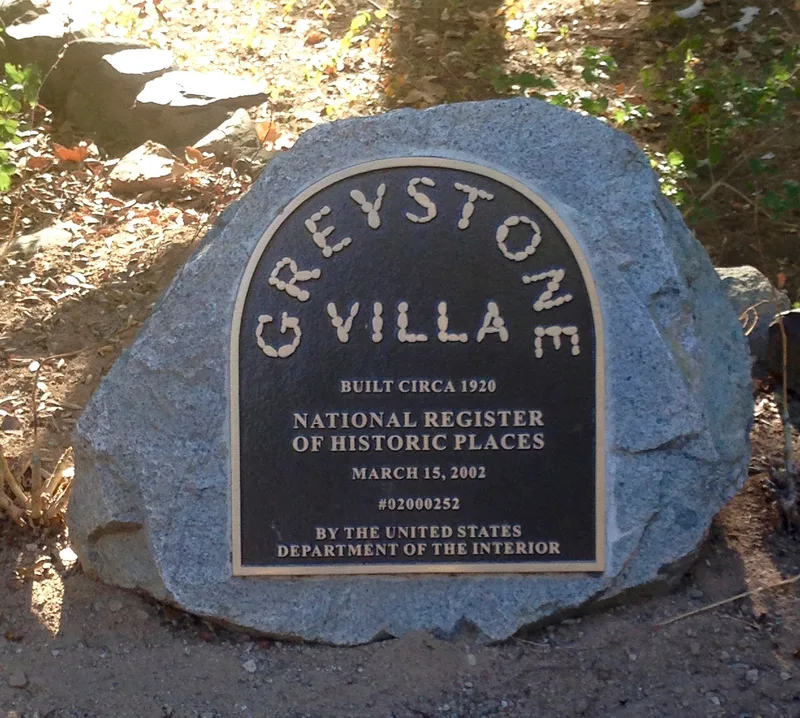
Built around 1929-30 in Sievers Canyon, within the Cleveland National Forest in Orange County, California, Greystone Villa (Cabin 18) is a small summer cabin that looks like a miniature medieval castle. Franklyn Z. Phillips, a Los Angeles builder, constructed it of gray and pinkish river rock and mortar, with two massive turrets, a flat roof behind a parapet pierced by nine decorated portholes, and a central fireplace. Stone-walled gardens, a fishpond with concrete deer, a stone bench and a Quonset-style storage shed surround it. The cabin was built when the Forest Service encouraged private summer homes on national forest land, and it is presented as an example of that early recreation use. It is also valued as an unusual blend of rustic vernacular architecture, Craftsman features and folk art. In the 1960s the sunken patio was enclosed, a bathroom and deck were added, and windows were replaced, but the original exterior walls remain intact. Its solid stone construction helped it survive fires, floods and earthquakes.
Significance in brief: The nomination argues it is a unique example of early twentieth-century folk art design and regional rustic/vernacular architecture, with Craftsman features, resembling a miniature medieval castle. It is also significant for its role in the early development of recreation, as a summer home permitted within a national forest.
Machine-generated summary. This summary was generated by a language model from the official nomination document and has not been reviewed line by line by an editor. It may contain errors. Check the source document before relying on any detail. Source: nomination document (PDF) · National Archives catalog entry. NRHP reference 02000151, listed March 15, 2002. Summary generated October 2026 (model claude-sonnet-5-5, prompt v1.0-2026-10-29, confidence medium).
Key facts
| Address | Sievers Canyon, Trabuco Ranger District, Cleveland National Forest |
|---|---|
| County | Orange County |
| Listed | March 15, 2002 |
| Reference number | 02000151 |
| Resource type | Building |
| Period of significance | 1929/30 |
| Architect / builder | Franklyn Z. Phillips |
| Architectural style | Regional Vernacular; Rustic/Folk Art Design/Twentieth Century; Craftsman Features |
| Criteria |
|
| Areas of significance | Entertainment/Recreation, Architecture |
| Level of significance | State |
| Status (as stated in the nomination) | Described as in continuous use as a gathering place for family, friends, guests and community groups; 1960s additions enclosed the patio and added a bathroom and deck, while the original exterior walls remain unaltered. |
| Acreage | 0.1 |
| Coordinates | 33.59022, -117.50497 (NPS GIS) |
What listing means for this property
National Register listing is honorary for a privately owned home: it does not by itself restrict what an owner may do with their own money, and it does not require public access. Restrictions come from local landmark or historic-district ordinances, which are separate (how they differ).
Owner-occupied houses are not eligible for the 20% federal rehabilitation tax credit, which applies to income-producing buildings, but many states offer credits for homeowners. Listing also opens the door to preservation easements and to buying a plaque. Start with what listing means for homeowners, renovating a listed house and selling one.
General information, not legal or tax advice. Rules change; confirm with your State Historic Preservation Office or a qualified adviser.
Sources and further reading
- National Park Service, National Register of Historic Places database (snapshot May 2026), reference 02000151.
- Nomination form (PDF, National Archives) — catalog entry
- Wikipedia article (used for cross-checking only; text not reproduced here)
- Wikidata Q28126043
- This listing as JSON
Last updated October 2026. Found an error? See the editorial policy for how to report it.