Sargent, Aaron A., House
Also known as: Sargent-Freeman Home
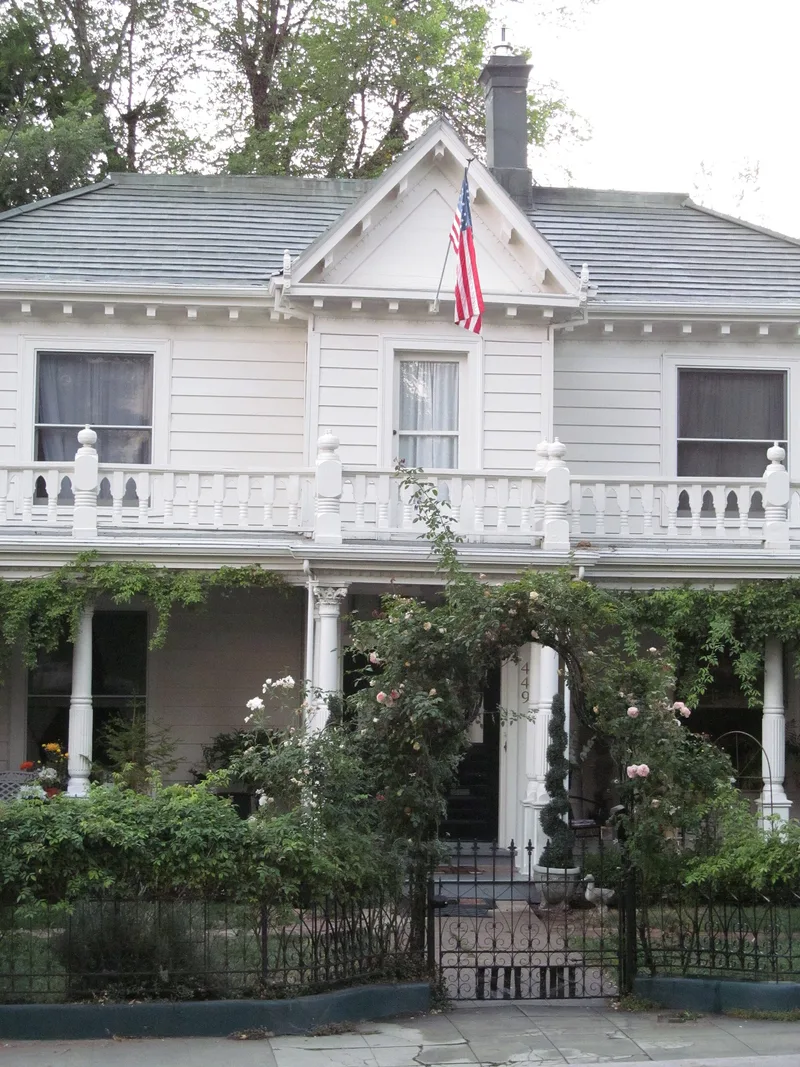

Why it's listed
Set on a 0.7-acre hillside site on Nevada City's Nabob Hill, this house was built in 1856 by Aaron Augustus Sargent after fire destroyed his earlier home on the same lot. Sargent, a printer, newspaper editor and lawyer, went on to serve in Congress and the U.S. Senate. He wrote the bill creating the Transcontinental Railroad and the 1878 suffrage amendment later known as the Anthony Amendment. His wife, Ellen Clark Sargent, founded the first women's suffrage group in Nevada County in 1869. Later owners included a bank president, a postmaster, and Dr. Carl Muller, who between 1900 and 1918 enlarged the house and gave it its Italianate look, with a long veranda and Corinthian columns. A copper roof was added in the 1920s, when a formal garden was also developed. A carriage house and barn with a turntable survives on the grounds, which hold a 140-foot sequoia and other notable plantings.
Significance in brief: The nomination argues the house is significant for its link to Aaron Augustus Sargent, a California political leader and U.S. Senator who authored the transcontinental railroad bill and the first women's suffrage amendment. It is also tied to his wife Ellen Clark Sargent, an early suffragist, and to later prominent local residents. The grounds are noted for landscape architecture and outstanding botanical specimens.
Machine-generated summary. This summary was generated by a language model from the official nomination document and has not been reviewed line by line by an editor. It may contain errors. Check the source document before relying on any detail. Source: nomination document (PDF) · National Archives catalog entry. NRHP reference 80000825, listed June 20, 1980. Summary generated October 2026 (model claude-sonnet-5-5, prompt v1.0-2026-10-29, confidence medium).
Key facts
| Address | 449 Broad St., Nevada City |
|---|---|
| County | Nevada County |
| Listed | June 20, 1980 |
| Reference number | 80000825 |
| Resource type | Building |
| Period of significance | 1852 to 1868 |
| Architectural style | Italianate |
| Areas of significance | Landscape Architecture, Health/Medicine, Law, Politics/Government, Social History |
| Level of significance | State |
| Status (as stated in the nomination) | Described as in good condition and occupied as a private residence; the carriage house is in good condition apart from board-and-batten siding due for replacement in 1980. |
| Acreage | 0.7 |
| Coordinates | 39.26342, -121.02158 (NPS GIS) |
What listing means for this property
National Register listing is honorary for a privately owned home: it does not by itself restrict what an owner may do with their own money, and it does not require public access. Restrictions come from local landmark or historic-district ordinances, which are separate (how they differ).
Owner-occupied houses are not eligible for the 20% federal rehabilitation tax credit, which applies to income-producing buildings, but many states offer credits for homeowners. Listing also opens the door to preservation easements and to buying a plaque. Start with what listing means for homeowners, renovating a listed house and selling one.
General information, not legal or tax advice. Rules change; confirm with your State Historic Preservation Office or a qualified adviser.
Sources and further reading
- National Park Service, National Register of Historic Places database (snapshot May 2026), reference 80000825.
- Nomination form (PDF, National Archives) — catalog entry
- Wikipedia article (used for cross-checking only; text not reproduced here)
- Wikidata Q4661790
- This listing as JSON
Last updated October 2026. Found an error? See the editorial policy for how to report it.