Empire Mine
Also known as: Empire Mine State Historic Park

Why it's listed
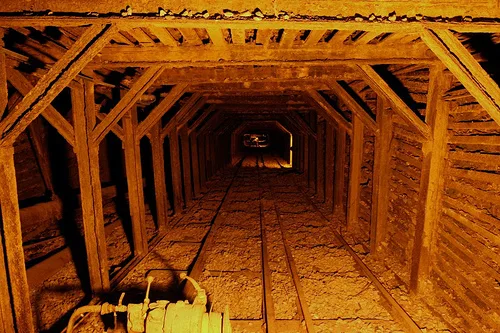
Empire Mine State Historic Park in Grass Valley preserves the surface buildings of one of the richest gold mines in the world. Mining began after George D. Roberts found a gold-bearing ledge on the hillside in 1850. The mine passed through several owners, and William B. Bourn took over management in 1867. It later merged with the neighboring Pennsylvania and North Star groups. When it closed in 1956, it was the oldest quartz mine in continuous operation in the United States, with an estimated $120 million in gold recovered. Surviving structures include the 1896 Bourn mansion, built of rough granite and brick, the mine office and refinery, and the circa 1905 clubhouse. San Francisco architect Willis Polk designed the mansion, office and clubhouse. Quarry stone from the mine was used in the walls. The mansion sits among tall pines, behind ornate brick and rock walls, and shows its age through weathered mortar and broken leaded windows.
Significance in brief: The Empire Mine was the oldest quartz mine in continuous operation in the United States when it closed in 1956, and it yielded an estimated $120 million in gold. The nomination also stresses the architectural value of the Polk-designed buildings built for mine owner William B. Bourn II, with their restrained forms and local stone and brick construction.
Machine-generated summary. This summary was generated by a language model from the official nomination document and has not been reviewed line by line by an editor. It may contain errors. Check the source document before relying on any detail. Source: nomination document (PDF) · National Archives catalog entry. NRHP reference 77000318, listed December 9, 1977. Summary generated October 2026 (model claude-sonnet-5-5, prompt v1.0-2026-10-29, confidence medium).
Key facts
| Address | SE of Grass Valley at 338 E. Empire St., Grass Valley |
|---|---|
| County | Nevada County |
| Listed | December 9, 1977 |
| Reference number | 77000318 |
| Resource type | District |
| Period of significance | 1800-1899, 1900- |
| Architect / builder | Willis Polk (architect); William B. Bourn, Jr. (owner) |
| Areas of significance | Industry, Architecture |
| Level of significance | State |
| Status (as stated in the nomination) | The Bourn mansion has not been lived in for several years and shows deterioration, vandalism and moisture damage, though it is considered in fair condition. The clubhouse is leased to the Empire Club and described as in fair to good condition. The property is a public state park and museum. |
| Acreage | 777 |
| Coordinates | 39.20352, -121.04906 (NPS GIS) |
What listing means for this property
This is a historic district. Buildings within its boundary are either contributing (they add to the district's significance) or non-contributing. Owners of contributing income-producing buildings can claim the 20% federal rehabilitation tax credit; homeowners should look at state credits. National Register districts impose no design review by themselves; a local historic district ordinance, if one exists, does (the difference explained).
General information, not legal or tax advice. Rules change; confirm with your State Historic Preservation Office or a qualified adviser.
Sources and further reading
- National Park Service, National Register of Historic Places database (snapshot May 2026), reference 77000318.
- Nomination form (PDF, National Archives) — catalog entry
- Wikipedia article (used for cross-checking only; text not reproduced here)
- Wikidata Q5374101
- This listing as JSON
Last updated October 2026. Found an error? See the editorial policy for how to report it.