Point Sur Light Station

Why it's listed
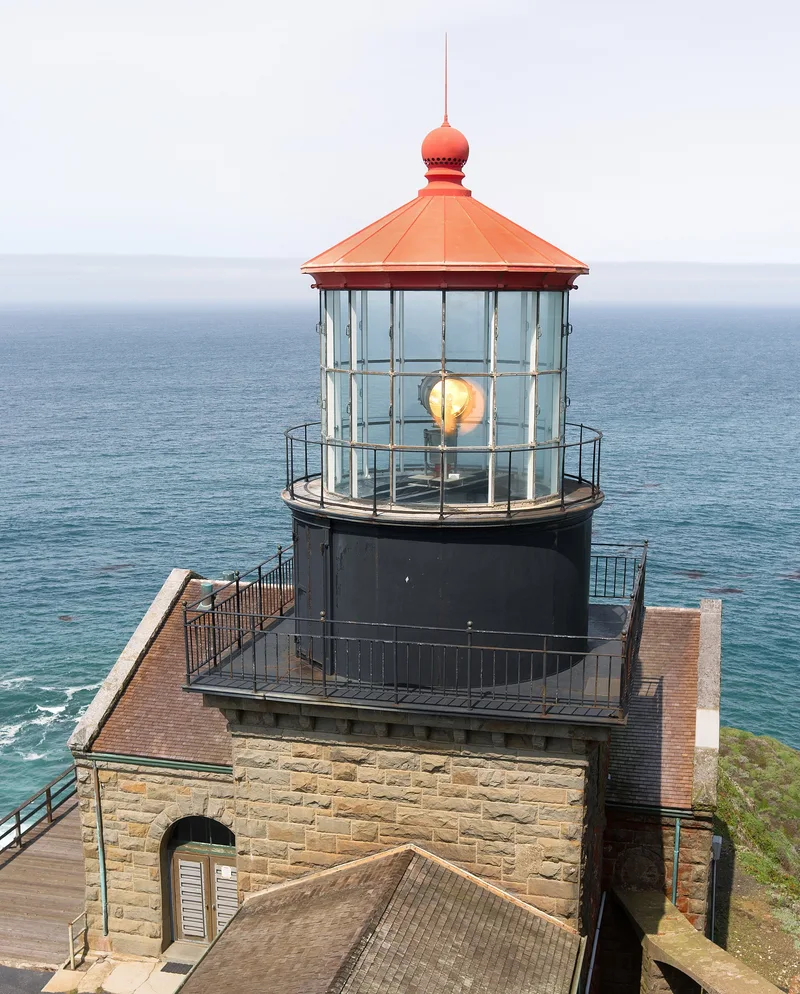
Perched on Morro Rock, a steep island-like landform beside the mainland beach south of Big Sur, this light station was built in 1889 to guide ships along the Central California coast. Before it opened, no lighthouse stood along 60 miles between Piedras Blancas and Monterey, and wrecks such as the SS Los Angeles in 1873 and the Ventura in 1875 had shown the need. Builders blasted building sites from the rock, quarried sandstone on the spot and hauled supplies up by incline railway. The complex includes a 42-foot stone light tower with attached fog-signal room, keeper's residence, assistant keeper's triplex, barn, blacksmith and carpenter's shop, oil house and cistern. Its Richardsonian Romanesque stonework is unusual among California light stations. Only the landing and boat house are gone, which makes it one of the most intact light stations on the West Coast. It was recognized for its maritime history and its architecture, with a significance period of 1889 to 1940.
Significance in brief: The station is significant under Criteria A and C. It is tied to California's reliance on maritime transportation and navigation aids. It also keeps nearly all its original buildings, and three of them are sandstone buildings in Richardsonian Romanesque style, built from stone quarried on the site.
Machine-generated summary. This summary was generated by a language model from the official nomination document and has not been reviewed line by line by an editor. It may contain errors. Check the source document before relying on any detail. Source: nomination document (PDF) · National Archives catalog entry. NRHP reference 91001097, listed September 3, 1991. Summary generated October 2026 (model claude-sonnet-5-5, prompt v1.0-2026-10-29, confidence high).
Key facts
| Address | Morro Rock on Point Sur, 0.5 mi. W of CA 1, Big Sur |
|---|---|
| County | Monterey County |
| Listed | September 3, 1991 |
| Reference number | 91001097 |
| Resource type | District |
| Period of significance | 1889-1940 |
| Architectural style | Romanesque; Renaissance (Richardsonian Romanesque lighthouse and stone buildings, with some Gothic features in the assistant keeper's dwelling) |
| Criteria |
|
| Areas of significance | Commerce, Transportation, Architecture, Maritime History |
| Level of significance | State |
| Status (as stated in the nomination) | Current function listed as vacant; the assistant keeper's dwelling is unoccupied and the keeper's residence has boarded openings. The lighthouse is in excellent repair, though its 1st order Fresnel lens was removed in 1979. The property was transferred to the State of California for park use. |
| Acreage | 37 |
| Coordinates | 36.30600, -121.90080 (NPS GIS) |
What listing means for this property
This is a historic district. Buildings within its boundary are either contributing (they add to the district's significance) or non-contributing. Owners of contributing income-producing buildings can claim the 20% federal rehabilitation tax credit; homeowners should look at state credits. National Register districts impose no design review by themselves; a local historic district ordinance, if one exists, does (the difference explained).
Noted as vacant in the nomination. Nomination documents can be decades old; current status may differ. If you are considering buying an empty listed property, read the due-diligence checklist.
General information, not legal or tax advice. Rules change; confirm with your State Historic Preservation Office or a qualified adviser.
Sources and further reading
- National Park Service, National Register of Historic Places database (snapshot May 2026), reference 91001097.
- Nomination form (PDF, National Archives) — catalog entry
- Wikipedia article (used for cross-checking only; text not reproduced here)
- Wikidata Q7208173
- This listing as JSON
Last updated October 2026. Found an error? See the editorial policy for how to report it.