Castroville Japanese Language School
Also known as: Castroville Nihon Gakko

Why it's listed
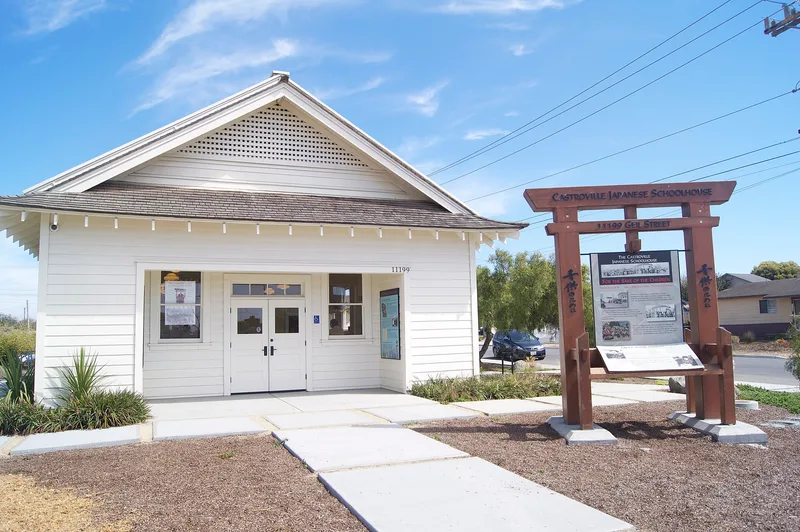
Built in 1936 on the corner of Pajaro and Geil streets in Castroville, this plain rectangular wood-frame building served a Japanese farming community as a language school, Buddhist temple and meeting hall. It sits on concrete piers, has shiplap walls and a shingled roof, and its only distinctive feature is a slightly hipped, temple-style roof with exposed rafters and simple lattice ventilation. Inside, a large assembly room, a niche for an altar, a kitchen and storage for funerary urns made up the floor plan. Children attended the public elementary school across the street and then walked over for language lessons. The community used the building for only six years. After Executive Order 9066 in February 1942, its members were sent to camps, and the building was left empty apart from brief use as a hostel by returning internees. The nomination presents it as a reminder of the discrimination faced by Japanese Americans and of a farming community that was dispersed.
Significance in brief: The nomination argues the building symbolizes the denial of constitutional rights to Japanese Americans, as the community lost it after Executive Order 9066 in February 1942. It is also significant for education and social history, since it housed language classes, religious services and gatherings for a poor farming community. It was left unused after the 1942 evacuation, except for brief use as a hostel for returning internees.
Machine-generated summary. This summary was generated by a language model from the official nomination document and has not been reviewed line by line by an editor. It may contain errors. Check the source document before relying on any detail. Source: nomination document (PDF) · National Archives catalog entry. NRHP reference 95001127, listed October 10, 1995. Summary generated October 2026 (model claude-sonnet-5-5, prompt v1.0-2026-10-29, confidence high).
Key facts
| Address | 11199 Geil St., Castroville |
|---|---|
| County | Monterey County |
| Listed | October 10, 1995 |
| Reference number | 95001127 |
| Resource type | Building |
| Period of significance | 1936-1942, 1944-1945 |
| Architect / builder | Kobayashi/Master Carpenter; Keizo Motokane/Master Carpenter |
| Architectural style | Other/Hipped Temple Roof |
| Criteria |
|
| Areas of significance | Social History, Education, Asian |
| Level of significance | Local |
| Status (as stated in the nomination) | Described as abandoned in 1942 and never reoccupied apart from brief use as a hostel; current function listed as vacant/not in use. Roof shows neglect and weather damage, but historic integrity is described as good. |
| Acreage | 0.9 |
| Coordinates | 36.76510, -121.75108 (NPS GIS) |
What listing means for this property
For a publicly owned building or structure, listing mainly matters when federal funds, permits or licences are involved: projects then go through Section 106 review so effects on the property are considered. Listing also strengthens applications for preservation grants and, for leased income-producing uses, can enable the federal rehabilitation tax credit.
Noted as vacant in the nomination. Nomination documents can be decades old; current status may differ. If you are considering buying an empty listed property, read the due-diligence checklist.
General information, not legal or tax advice. Rules change; confirm with your State Historic Preservation Office or a qualified adviser.
Sources and further reading
- National Park Service, National Register of Historic Places database (snapshot May 2026), reference 95001127.
- Nomination form (PDF, National Archives) — catalog entry
- Wikipedia article (used for cross-checking only; text not reproduced here)
- Wikidata Q14681718
- This listing as JSON
Last updated October 2026. Found an error? See the editorial policy for how to report it.