Southwest Museum

Why it's listed
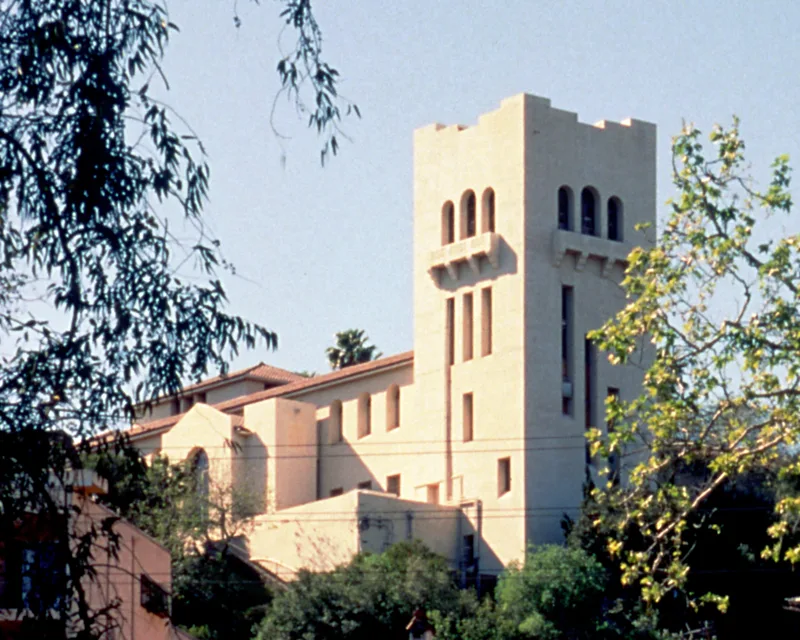
Perched on a hill above the Arroyo Seco in northeast Los Angeles, this museum was built between 1912 and 1914 to house Native American and Hispanic collections. Architect Sumner Hunt designed the reinforced concrete building in the Spanish Colonial Revival style, with off-white stucco, a red tile roof, deeply recessed windows, a tall east tower and a shorter west tower. A 1920 tunnel and elevator entrance, designed by Allison and Allison with Marguerite Tew, ends in a Mayan Revival portal. A 1940-41 wing and a 1970s library were added later. The museum reflects the life work of Charles Fletcher Lummis, a collector, writer and early preservationist who founded the Landmarks Club to save California's missions and insisted on the spiral tower for his library. The building is also notable for withstanding earthquakes and for an architectural style that matches the cultures its exhibits present.
Significance in brief: It is tied to Charles Fletcher Lummis, a prominent Los Angeles figure who founded the museum to preserve Native American and Hispanic heritage (Criterion B). It is also a leading example of the Spanish Colonial Revival style developed by architect Sumner Hunt (Criterion C). The tunnel portal is a rare surviving example of 1920s exotic revival design.
Machine-generated summary. This summary was generated by a language model from the official nomination document and has not been reviewed line by line by an editor. It may contain errors. Check the source document before relying on any detail. Source: nomination document (PDF) · National Archives catalog entry. NRHP reference 92001270, listed March 11, 2004. Summary generated October 2026 (model claude-sonnet-5-5, prompt v1.0-2026-10-29, confidence high).
Key facts
| Address | 234 Museum Dr., Los Angeles |
|---|---|
| County | Los Angeles County |
| Listed | March 11, 2004 |
| Reference number | 92001270 |
| Resource type | Building |
| Period of significance | 1912-28 |
| Architect / builder | Hunt, Sumner |
| Architectural style | Spanish Colonial Revival; Mayan Revival (tunnel portal) |
| Criteria |
|
| Areas of significance | Prehistoric, Conservation, Architecture |
| Level of significance | National, State |
| Status (as stated in the nomination) | Still in use as a museum; the tunnel entrance was reported as no longer in service due to budget cuts. |
| Acreage | 12 |
| Coordinates | 34.10034, -118.20665 (NPS GIS) |
What listing means for this property
National Register listing is honorary: it recognises significance and does not restrict what a private owner may do without federal money or permits. It unlocks the 20% federal rehabilitation tax credit for income-producing buildings, state credits in many states, and Section 106 review when federal agencies are involved. See what listing means in practice.
General information, not legal or tax advice. Rules change; confirm with your State Historic Preservation Office or a qualified adviser.
Sources and further reading
- National Park Service, National Register of Historic Places database (snapshot May 2026), reference 92001270.
- Nomination form (PDF, National Archives) — catalog entry
- Wikipedia article (used for cross-checking only; text not reproduced here)
- Wikidata Q5414729
- This listing as JSON
Last updated October 2026. Found an error? See the editorial policy for how to report it.