Hangar One

Why it's listed
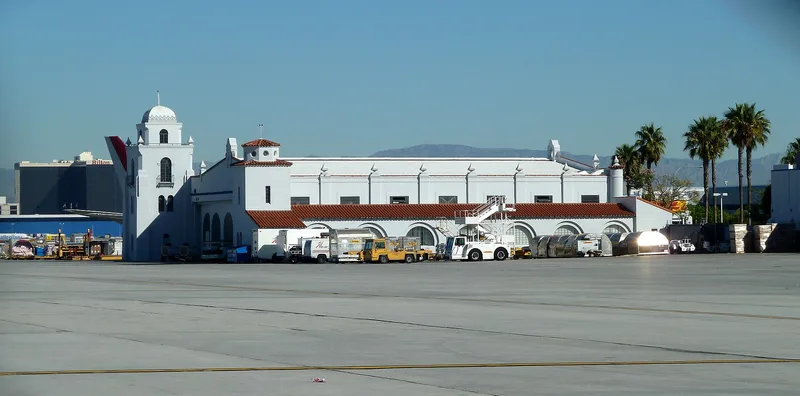
Hangar One is a Spanish Colonial Revival hangar on the cargo tarmac of Los Angeles International Airport. Built in 1929 by the Curtiss-Wright Company on land leased from the City, it was the first hangar at Mines Field, the site chosen for the municipal airport. Architects Gable and Wyant gave it a red tile roof, arched openings, and corner towers, a departure from the corrugated iron typical of hangars then. It could house about 18 aircraft and served as a training headquarters and flying school. Shortly after completion, the German dirigible Graf Zeppelin anchored at its tarmac during a refueling stop, and the airport hosted National Air Races in 1928, 1933, and 1936. Pilots such as Charles Lindbergh and James Doolittle used the hangar, and later tenants included the Army Air Forces. It is the only building remaining from the airport's original development and has been rehabilitated while retaining its original openings and orientation.
Significance in brief: The nomination argues the hangar is significant for its association with Southern California's aviation industry. It was the first hangar built at Los Angeles Municipal Airport (Mines Field) and is the only structure remaining from the original airport. It hosted events such as the Graf Zeppelin's refueling stop and the National Air Races, and was used by many famous aviators.
Machine-generated summary. This summary was generated by a language model from the official nomination document and has not been reviewed line by line by an editor. It may contain errors. Check the source document before relying on any detail. Source: nomination document (PDF) · National Archives catalog entry. NRHP reference 92000959, listed July 30, 1992. Summary generated October 2026 (model claude-sonnet-5-5, prompt v1.0-2026-10-29, confidence high).
Key facts
| Address | 5701 W. Imperial Hwy., Los Angeles |
|---|---|
| County | Los Angeles County |
| Listed | July 30, 1992 |
| Reference number | 92000959 |
| Resource type | Building |
| Period of significance | 1929-1942 |
| Architect / builder | Gable & Wyant |
| Architectural style | Mission/Spanish Colonial Revival |
| Criteria |
|
| Areas of significance | Transportation |
| Level of significance | National |
| Status (as stated in the nomination) | Described as substantially intact and rehabilitated following the Secretary of the Interior's Standards; still used for air-related transportation. It retains its historic orientation to the runway. |
| Acreage | 8.8 |
| Coordinates | 33.93351, -118.38451 (NPS GIS) |
What listing means for this property
National Register listing is honorary: it recognises significance and does not restrict what a private owner may do without federal money or permits. It unlocks the 20% federal rehabilitation tax credit for income-producing buildings, state credits in many states, and Section 106 review when federal agencies are involved. See what listing means in practice.
General information, not legal or tax advice. Rules change; confirm with your State Historic Preservation Office or a qualified adviser.
Sources and further reading
- National Park Service, National Register of Historic Places database (snapshot May 2026), reference 92000959.
- Nomination form (PDF, National Archives) — catalog entry
- Wikipedia article (used for cross-checking only; text not reproduced here)
- Wikidata Q5647903
- This listing as JSON
Last updated October 2026. Found an error? See the editorial policy for how to report it.