Errea House

Why it's listed
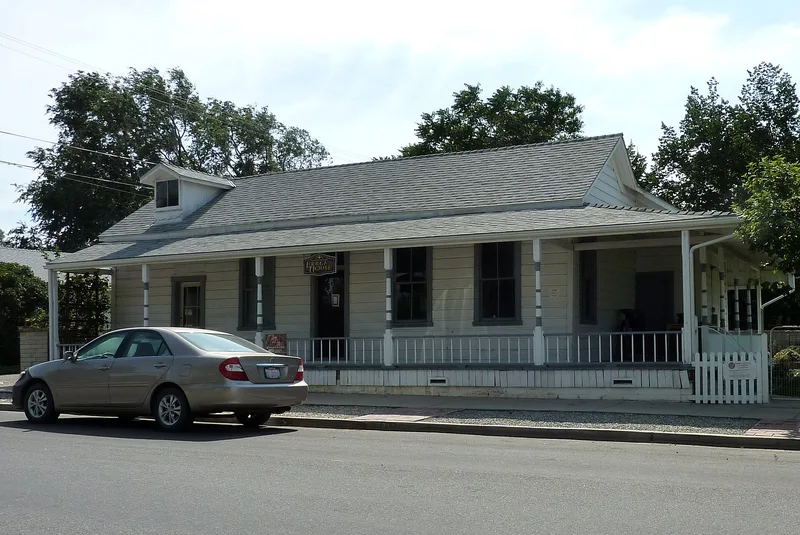
This small wood-frame house at 311 S. Green Street in downtown Tehachapi is the only surviving building from Tehichipa, the first settlement in the Tehachapi Valley. Built between about 1870 and 1875, it was moved on log rollers to its present site around 1900, when businesses and residents relocated to the new railroad town after the Southern Pacific bypassed Tehichipa. The house has one story, an attic with a dormer, a concrete foundation, ship lap siding, a wraparound wood porch, and trim that gives it a Greek Revival look. A west porch was enclosed after the 1952 earthquake. The Errea family owned it for about 75 years, until 1992. It was listed for its link to early settlement, as the last visible evidence of Tehichipa. It also qualified as a moved property because it is the sole surviving structure tied to the area's oldest community. It sits across from the Tehachapi Museum.
Significance in brief: It is the last surviving structure from Tehichipa, the first settlement in the Tehachapi area, which declined after the Southern Pacific Railroad bypassed it. Its move reflects the relocation of the town's buildings to the new railroad town. It meets Criterion A in Exploration/Settlement and Criteria Consideration B for moved properties.
Machine-generated summary. This summary was generated by a language model from the official nomination document and has not been reviewed line by line by an editor. It may contain errors. Check the source document before relying on any detail. Source: nomination document (PDF) · National Archives catalog entry. NRHP reference 97000809, listed July 29, 1997. Summary generated October 2026 (model claude-sonnet-5-5, prompt v1.0-2026-10-29, confidence high).
Key facts
| Address | 311 S. Green St., Tehachapi |
|---|---|
| County | Kern County |
| Listed | July 29, 1997 |
| Reference number | 97000809 |
| Resource type | Building |
| Period of significance | c. 1870, amended to add c. 1900 |
| Architectural style | Greek Revival |
| Criteria |
|
| Areas of significance | Exploration/Settlement |
| Level of significance | Local |
| Status (as stated in the nomination) | Historic function listed as single-dwelling domestic use; current functions listed as work in progress and museum. The Errea family owned it until 1992. |
| Acreage | 0.1 |
| Coordinates | 35.12930, -118.44793 (NPS GIS) |
What listing means for this property
National Register listing is honorary for a privately owned home: it does not by itself restrict what an owner may do with their own money, and it does not require public access. Restrictions come from local landmark or historic-district ordinances, which are separate (how they differ).
Owner-occupied houses are not eligible for the 20% federal rehabilitation tax credit, which applies to income-producing buildings, but many states offer credits for homeowners. Listing also opens the door to preservation easements and to buying a plaque. Start with what listing means for homeowners, renovating a listed house and selling one.
General information, not legal or tax advice. Rules change; confirm with your State Historic Preservation Office or a qualified adviser.
Sources and further reading
- National Park Service, National Register of Historic Places database (snapshot May 2026), reference 97000809.
- Nomination form (PDF, National Archives) — catalog entry
- Wikipedia article (used for cross-checking only; text not reproduced here)
- Wikidata Q14681938
- This listing as JSON
Last updated October 2026. Found an error? See the editorial policy for how to report it.