Manzanar War Relocation Center, National Historic Site
Also known as: Manzanar Internment Camp; Manzanar Concentration Camp

Why it's listed
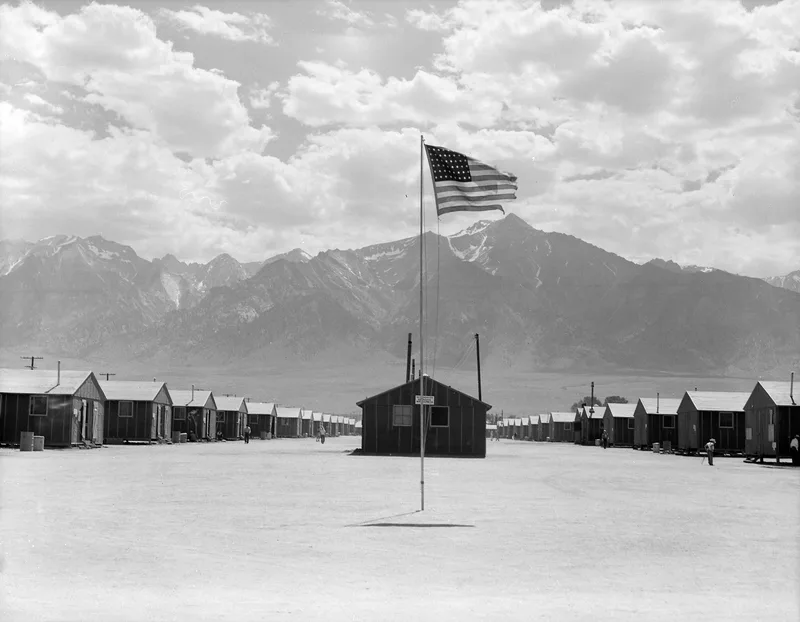
Manzanar was a World War II confinement camp in Owens Valley, California, about ten miles north of Lone Pine. After Executive Order 9066 was signed in February 1942, it became the first of ten camps built to hold people of Japanese ancestry. The Army Corps of Engineers directed construction, and the living area held 36 blocks of tar-paper barracks, each with a mess hall, laundry and bath house, and latrines. At its peak about 10,000 people lived there, and residents set up their own kitchens, hospital, schools and recreation facilities. The camp closed in November 1945. Today the desert has reclaimed much of the site, but cement foundations, stone steps, remains of tea gardens, an auditorium, two stone sentry posts and the Soul Consoling Tower remain. The site was listed because it represents the imprisonment of more than 110,000 people, most of them American citizens, and because it remains an important symbol to Japanese Americans. It was named California Historic Landmark #850 in 1972.
Significance in brief: The nomination presents Manzanar as a symbol of a lamentable period in American history, when over 110,000 people of Japanese ancestry, most of them American citizens, were held by their own nation. It is described as the first camp built and as an important symbol to many Japanese Americans today.
Machine-generated summary. This summary was generated by a language model from the official nomination document and has not been reviewed line by line by an editor. It may contain errors. Check the source document before relying on any detail. Source: nomination document (PDF) · National Archives catalog entry. NRHP reference 76000484, listed July 30, 1976. Summary generated October 2026 (model claude-sonnet-5-5, prompt v1.0-2026-10-29, confidence medium).
Key facts
| Address | 6 mi. S of Independence on CA 395, Independence |
|---|---|
| County | Inyo County |
| Listed | July 30, 1976 |
| Reference number | 76000484 |
| Resource type | Site |
| Period of significance | March, 1942 - September (end date truncated in the text) |
| Architect / builder | U.S. Army Corps of Engineers (construction direction) |
| Areas of significance | Social History, Asian, Military |
| Level of significance | National |
| National Historic Landmark | Yes, designated February 4, 1985 |
| Status (as stated in the nomination) | Campsite largely reclaimed by the desert after closure in 1945; remains include foundations, stone steps, a tea garden, an auditorium, two sentry posts, a stone house at the entrance, a cemetery and the Soul Consoling Tower. Form marks the condition as deteriorated and altered. |
| Acreage | 640 |
| Coordinates | 36.72833, -118.15444 (Wikidata) |
What listing means for this property
Sites (archaeological sites, battlefields, landscapes) are often listed with a restricted address to protect them from looting or disturbance. Listing is honorary for private owners; federal undertakings on or near the site go through Section 106 review, and state laws may protect burials and artefacts regardless of listing.
General information, not legal or tax advice. Rules change; confirm with your State Historic Preservation Office or a qualified adviser.
Sources and further reading
- National Park Service, National Register of Historic Places database (snapshot May 2026), reference 76000484.
- Nomination form (PDF, National Archives) — catalog entry
- Wikipedia article (used for cross-checking only; text not reproduced here)
- Wikidata Q985484
- This listing as JSON
Last updated October 2026. Found an error? See the editorial policy for how to report it.