Eagle Borax Works
Also known as: H.s.-1

Why it's listed
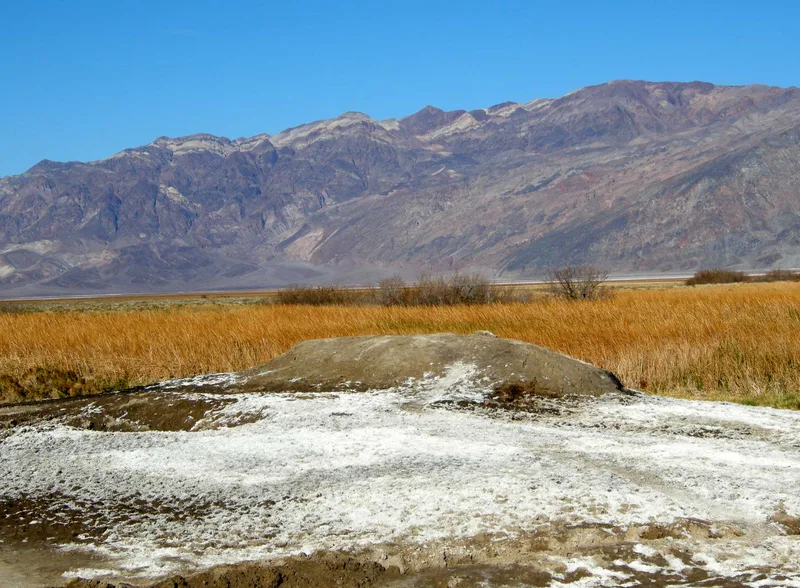
Eagle Borax Works is the ruin of the earliest borax plant in Death Valley, set near Bennetts Well in what is now Death Valley National Monument. Isidore Daunet, a French-born prospector who noticed borate deposits after a near-fatal summer crossing in 1880, formed a partnership in 1882 and brought in equipment, using water from a nearby spring. The plant heated water in a furnace and boiler, dissolved the borax in a tank and crystallized it in vats. Output was hauled by wagon to the railhead at Daggett; by the end of 1883 the partners had shipped 260,000 pounds. Work stopped in summer, when heat prevented crystallization. After Daunet's death in 1884 the business folded, and the land later passed to U.S. Borax, Borax Consolidated, and eventually the National Park Service. Today only the furnace fire box and earth mounds remain, with tamarisks overtaking native vegetation. The site is valued as a typical marsh-type operation and an interpretive opportunity.
Significance in brief: It was the site of the first borax plant in Death Valley and a typical marsh-type operation. It reflects the pioneer beginnings of borax mining and processing in the United States, which is closely tied to Death Valley. The form also notes its value for public interpretation.
Machine-generated summary. This summary was generated by a language model from the official nomination document and has not been reviewed line by line by an editor. It may contain errors. Check the source document before relying on any detail. Source: nomination document (PDF) · National Archives catalog entry. NRHP reference 74000338, listed December 31, 1974. Summary generated October 2026 (model claude-sonnet-5-5, prompt v1.0-2026-10-29, confidence medium).
Key facts
| Address | Death Valley National Monument, Furnace Creek |
|---|---|
| County | Inyo County |
| Listed | December 31, 1974 |
| Reference number | 74000338 |
| Resource type | District |
| Period of significance | 19th Century (specific date 1882) |
| Architect / builder | Isidore Daunet and partners (M. McDonald, M. Harmon, C.C. Blanch) set up the operation |
| Areas of significance | Industry, Transportation |
| Level of significance | State |
| Status (as stated in the nomination) | Described as ruins; little remains beyond the furnace fire box and earth mounds. Preservation work is marked in progress and stabilization in present condition is recommended. |
| Acreage | 54 |
| Coordinates | 36.20119, -116.86595 (NPS GIS) |
What listing means for this property
This is a historic district. Buildings within its boundary are either contributing (they add to the district's significance) or non-contributing. Owners of contributing income-producing buildings can claim the 20% federal rehabilitation tax credit; homeowners should look at state credits. National Register districts impose no design review by themselves; a local historic district ordinance, if one exists, does (the difference explained).
General information, not legal or tax advice. Rules change; confirm with your State Historic Preservation Office or a qualified adviser.
Sources and further reading
- National Park Service, National Register of Historic Places database (snapshot May 2026), reference 74000338.
- Nomination form (PDF, National Archives) — catalog entry
- Wikipedia article (used for cross-checking only; text not reproduced here)
- Wikidata Q5325030
- This listing as JSON
Last updated October 2026. Found an error? See the editorial policy for how to report it.