Pope Estate

Why it's listed
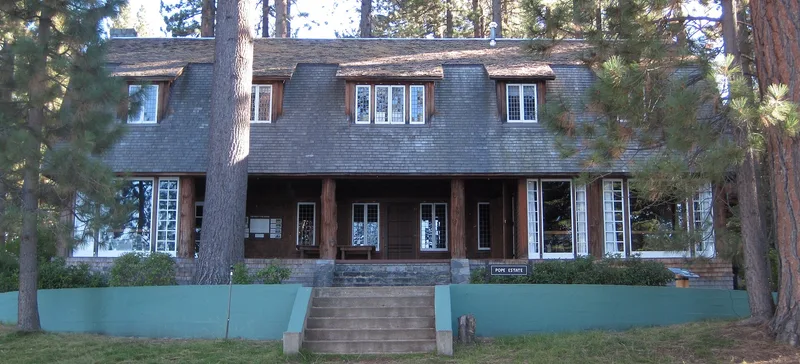
Set on the shore of Lake Tahoe, this estate is a group of about twenty buildings on roughly 32 acres. The centerpiece is a shingle-covered Main House built in 1884 by banker's son George Tallant, with a gambrel roof, bark-covered log porch columns, leaded-glass windows and finely finished paneled interiors. Around it stand a kitchen and dining building, guest and help cabins, a boathouse, barn, gazebo, caretaker's house and other outbuildings. Shingles, gabled roofs and diamond-paned windows give the complex a consistent English cottage character. The estate passed from Tallant to the Tevis family in 1899 and to George Pope in 1923, all prominent in California banking and finance. It was judged significant as an unusually complete picture of an early wealthy lakeside lifestyle, and as the oldest and most intact estate complex in the area. The Main House is among the oldest remaining estate houses there.
Significance in brief: The estate is significant for its architecture and for its history. The Main House is an early shingle-style lakeside house with notable interiors, and it set the style for the surrounding buildings. The complex is described as the oldest and most intact in the area, showing a vanished lifestyle of wealthy California banking families, including the Tallant, Tevis and Pope families.
Machine-generated summary. This summary was generated by a language model from the official nomination document and has not been reviewed line by line by an editor. It may contain errors. Check the source document before relying on any detail. Source: nomination document (PDF) · National Archives catalog entry. NRHP reference 87000495, listed April 1, 1987. Summary generated October 2026 (model claude-sonnet-5-5, prompt v1.0-2026-10-29, confidence medium).
Key facts
| Address | NW of US 50 and CA 89 jct. on N side of CA 89, South Lake Tahoe |
|---|---|
| County | El Dorado County |
| Listed | April 1, 1987 |
| Reference number | 87000495 |
| Resource type | Building |
| Period of significance | 1884-1920's |
| Architect / builder | Unknown (Main House built by George Tallant in 1884; architect unconfirmed, Ernest Coxhead suggested as a possible designer) |
| Architectural style | Shingle style with American and Dutch Colonial Revival influences and English cottage references |
| Areas of significance | Economics, Architecture |
| Level of significance | State |
| Status (as stated in the nomination) | Form lists the property as unoccupied, in fair to good condition with some deterioration and alterations. A 1979 windstorm destroyed the east sleeping porch of the Main House, and the gazebo is in disrepair. |
| Acreage | 32.5 |
| Coordinates | 38.93732, -120.04461 (NPS GIS) |
What listing means for this property
National Register listing is honorary for a privately owned home: it does not by itself restrict what an owner may do with their own money, and it does not require public access. Restrictions come from local landmark or historic-district ordinances, which are separate (how they differ).
Owner-occupied houses are not eligible for the 20% federal rehabilitation tax credit, which applies to income-producing buildings, but many states offer credits for homeowners. Listing also opens the door to preservation easements and to buying a plaque. Start with what listing means for homeowners, renovating a listed house and selling one.
Noted as vacant in the nomination. Nomination documents can be decades old; current status may differ. If you are considering buying an empty listed property, read the due-diligence checklist.
General information, not legal or tax advice. Rules change; confirm with your State Historic Preservation Office or a qualified adviser.
Sources and further reading
- National Park Service, National Register of Historic Places database (snapshot May 2026), reference 87000495.
- Nomination form (PDF, National Archives) — catalog entry
- Wikipedia article (used for cross-checking only; text not reproduced here)
- Wikidata Q16967424
- This listing as JSON
Last updated October 2026. Found an error? See the editorial policy for how to report it.