Grand Island Shrine
Also known as: Little Shrine at Sycamore, The

Why it's listed
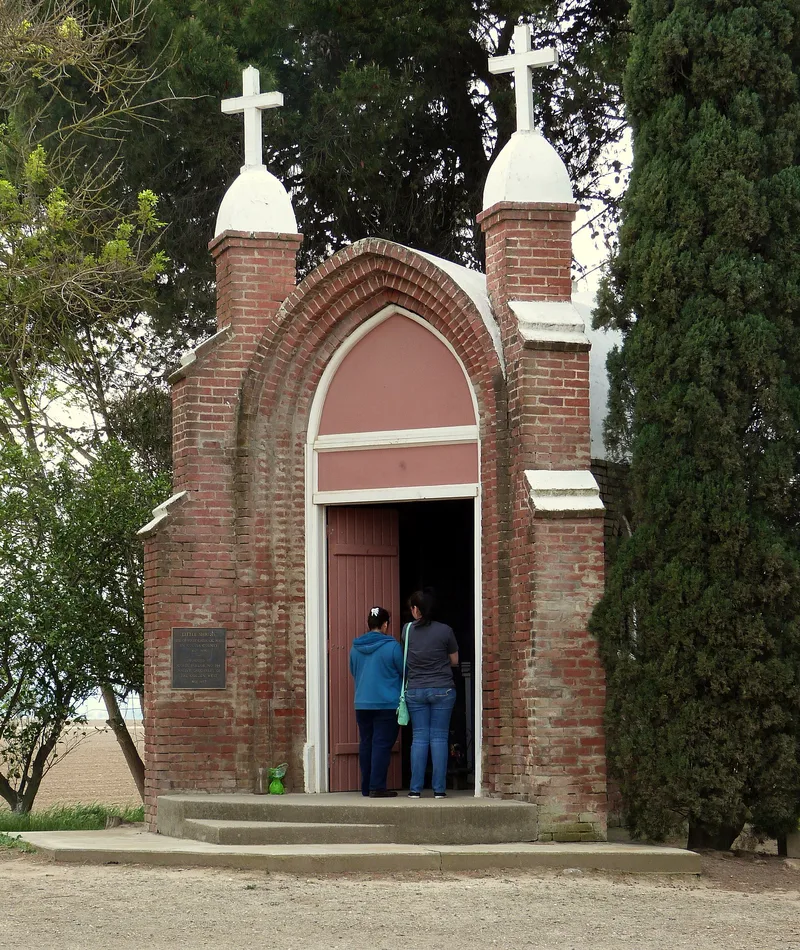
Standing alone in an open barley field off State Route 45 south of Colusa, this tiny brick chapel measures roughly 10 by 14 feet and is crowned by two buttressed towers topped with wooden crosses. Father Michael Wallrath built it in 1883 from leftover bricks he had kilned for the Colusa church, and dedicated it to Our Lady of Sorrows. Its walls are 12 inches thick, with a vaulted masonry roof held by iron tie rods and a Gothic arched doorway. The site matters for architecture, as an example of vernacular building, and for religion. Local Catholic families on Grand Island heard the first Mass in Colusa County here in 1856, and a mission cross later marked the spot. Mass has been said at the shrine regularly since the chapel was built, and visitors from across the United States and Canada have signed its register. A bronze plaque placed in 1957 commemorates the first Mass.
Significance in brief: The nomination argues it is a unique example of vernacular or folk architecture, a small Gothic brick structure standing in an open barley field. It also marks the site of the first Mass in Colusa County in 1856 and has been used for worship and pilgrimage since 1883.
Machine-generated summary. This summary was generated by a language model from the official nomination document and has not been reviewed line by line by an editor. It may contain errors. Check the source document before relying on any detail. Source: nomination document (PDF) · National Archives catalog entry. NRHP reference 74000508, listed December 31, 1974. Summary generated October 2026 (model claude-sonnet-5-5, prompt v1.0-2026-10-29, confidence high).
Key facts
| Address | 8 mi. S of Colusa on CA 45, Colusa |
|---|---|
| County | Colusa County |
| Listed | December 31, 1974 |
| Reference number | 74000508 |
| Resource type | Building |
| Period of significance | 19th Century |
| Architect / builder | Father Wallrath (architect-builder) |
| Architectural style | Vernacular or folk architecture with Gothic details |
| Areas of significance | Architecture, Religion |
| Level of significance | Local |
| Status (as stated in the nomination) | Condition listed as good and unaltered on its original site; the form states it is unoccupied but still used for Mass and visits, and its doors are always unlocked. |
| Acreage | 0.5 |
| Coordinates | 39.11562, -121.93716 (NPS GIS) |
What listing means for this property
National Register listing is honorary: it recognises significance and does not restrict what a private owner may do without federal money or permits. It unlocks the 20% federal rehabilitation tax credit for income-producing buildings, state credits in many states, and Section 106 review when federal agencies are involved. See what listing means in practice.
General information, not legal or tax advice. Rules change; confirm with your State Historic Preservation Office or a qualified adviser.
Sources and further reading
- National Park Service, National Register of Historic Places database (snapshot May 2026), reference 74000508.
- Nomination form (PDF, National Archives) — catalog entry
- Wikipedia article (used for cross-checking only; text not reproduced here)
- Wikidata Q14682056
- This listing as JSON
Last updated October 2026. Found an error? See the editorial policy for how to report it.