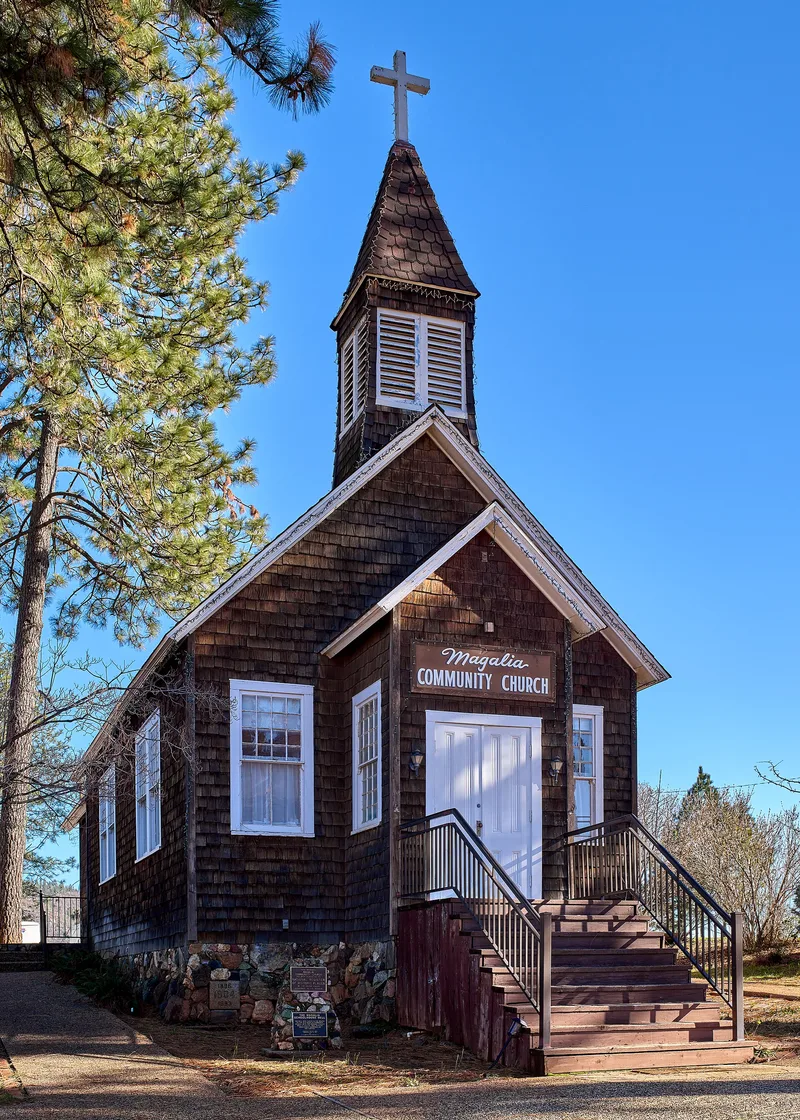
Magalia Community Church

Why it's listed
Magalia Community Church is a small, simple Protestant church in the old mining town of Magalia, Butte County. Volunteers built it in 1904 from the salvaged materials of an 1896 meeting house that had stood on private land nearby. The rectangular sanctuary measures about 20 by 40 feet, with a rubble foundation, redwood shingle siding, a small vestibule, a belfry and a shed-roofed kitchen at the rear. Carrie Brydon, a Women's Christian Temperance Union member, led the effort to move and rebuild it, with funds raised from union members and a major gift from Annie K. Bidwell. The church was added to the national register in 1982 for its role as the religious and social center of an isolated town and for its link to the temperance movement. It was the town's oldest building used for its original purpose. Any Protestant denomination could hold services there. In 1993 approval was given to move it a short distance to avoid demolition after the land was sold.
Significance in brief: The nomination argues the church is significant for its role in the social and religious development of an isolated mountain town. It is the town's oldest building still used for its original purpose. It also has a long association with the Women's Christian Temperance Union, which reflects the influence of women's reform groups in early twentieth-century small-town America.
Machine-generated summary. This summary was generated by a language model from the official nomination document and has not been reviewed line by line by an editor. It may contain errors. Check the source document before relying on any detail. Source: nomination document (PDF) · National Archives catalog entry. NRHP reference 82002172, listed January 11, 1982. Summary generated October 2026 (model claude-sonnet-5-5, prompt v1.0-2026-10-29, confidence medium).
Key facts
| Address | Stirling Hwy., Magalia |
|---|---|
| County | Butte County |
| Listed | January 11, 1982 |
| Reference number | 82002172 |
| Resource type | Building |
| Period of significance | 1904-1931 |
| Architect / builder | None (designed and built by parishioners and volunteers) |
| Architectural style | Simple vernacular Protestant church |
| Criteria |
|
| Areas of significance | Religion, Social History |
| Level of significance | Local |
| Status (as stated in the nomination) | Condition listed as fair at nomination, with major foundation and floor joist repairs needed. A 1992-93 request to move the building about 150 yards south, because the property was sold and the building threatened with removal, was approved. Services were still held. |
| Acreage | 0.1 |
| Coordinates | 39.80982, -121.57877 (NPS GIS) |
What listing means for this property
Religious properties are listed for their architectural or historical significance, not their religious use. Listing is honorary and does not restrict the congregation's use of the building. The federal rehabilitation credit is generally unavailable unless part of the building is income-producing; some state programmes and preservation grants do cover religious buildings. Federal funding or permits trigger Section 106 review.
General information, not legal or tax advice. Rules change; confirm with your State Historic Preservation Office or a qualified adviser.
Sources and further reading
- National Park Service, National Register of Historic Places database (snapshot May 2026), reference 82002172.
- Nomination form (PDF, National Archives) — catalog entry
- Wikipedia article (used for cross-checking only; text not reproduced here)
- Wikidata Q14683240
- This listing as JSON
Last updated October 2026. Found an error? See the editorial policy for how to report it.