Fiddletown

Why it's listed
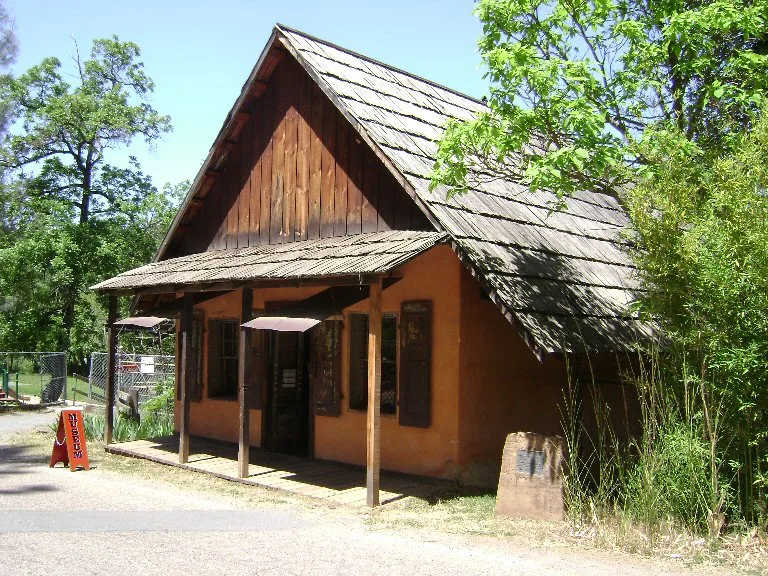
Fiddletown is a former gold rush town in the Sierra Nevada foothills of Amador County, six miles northeast of Plymouth. Settlers from Missouri founded it in 1849, and by 1853 about 100 homes and businesses lined Main and Jibboom Streets on either side of Dry Creek. It served as a trading center for nearby placer mining camps and had a steam sawmill and local brickmaking. Surviving buildings include brick stores with iron doors, an 1870 blacksmith and wagon shop of hand-hewn tuff blocks, a Gothic Revival house, a Classic Revival cottage, an 1860 schoolhouse and an 1856 cemetery. West of town, a Chinese settlement left adobe, rock and rammed-earth buildings. The Chew Kee Store still holds its original herb shop contents and artifacts, regarded as an exceptional record of Chinese-American culture. Some twentieth-century buildings intrude, but the town keeps the feel of a quiet nineteenth-century village.
Significance in brief: The district retains many buildings from the 1850s gold rush, including brick, adobe, rammed-earth and tuff structures. Its Chinese settlement, especially the Chew Kee Store with its intact herb shop and artifacts, is described as a rare record of early Chinese-American life. The town kept its rural mid-to-late 19th century feeling despite some modern intrusions.
Machine-generated summary. This summary was generated by a language model from the official nomination document and has not been reviewed line by line by an editor. It may contain errors. Check the source document before relying on any detail. Source: nomination document (PDF) · National Archives catalog entry. NRHP reference 78000655, listed June 7, 1978. Summary generated October 2026 (model claude-sonnet-5-5, prompt v1.0-2026-10-29, confidence medium).
Key facts
| Address | Off CA 49, Fiddletown |
|---|---|
| County | Amador County |
| Listed | June 7, 1978 |
| Reference number | 78000655 |
| Resource type | District |
| Period of significance | 1800-1899 |
| Architectural style | Gold Rush era vernacular, with Classic Revival and Gothic Revival buildings |
| Areas of significance | Exploration/Settlement, Architecture |
| Level of significance | State |
| Status (as stated in the nomination) | Altered but in fair condition and largely occupied; the Cooper House was partly burned in 1975, with restoration planned. The Chew Kee Store is open some weekends as a museum. |
| Acreage | 100 |
| Coordinates | 38.50502, -120.76177 (NPS GIS) |
What listing means for this property
This is a historic district. Buildings within its boundary are either contributing (they add to the district's significance) or non-contributing. Owners of contributing income-producing buildings can claim the 20% federal rehabilitation tax credit; homeowners should look at state credits. National Register districts impose no design review by themselves; a local historic district ordinance, if one exists, does (the difference explained).
General information, not legal or tax advice. Rules change; confirm with your State Historic Preservation Office or a qualified adviser.
Sources and further reading
- National Park Service, National Register of Historic Places database (snapshot May 2026), reference 78000655.
- Nomination form (PDF, National Archives) — catalog entry
- Wikipedia article (used for cross-checking only; text not reproduced here)
- Wikidata Q3476022
- This listing as JSON
Last updated October 2026. Found an error? See the editorial policy for how to report it.